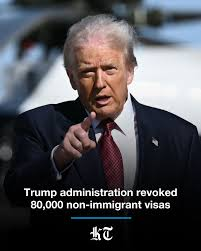
TRUMP ADMINISTRATION HAS REVOKED 80.000 US NON-IMMIGRANT VISAS IN 2025
#USVisa #VisaRevocation #ImmigrationNews #USImmigration #NonImmigrantVisa #VisaUpdate #BreakingNews #ImmigrationLaw #StudentVisa #TouristVisa #USStateDepartment #VisaBan
“Major breaking immigration news: The U.S. has revoked around 80,000 non-immigrant visas since early 2025. This is one of the largest waves of visa cancellations in recent history. Today I’ll explain why this is happening, who is affected, and what visa-holders need to know moving forward.” 1. What Happened? “The U.S. State Department confirmed that nearly 80,000 visas—mostly non-immigrant visas like tourist, business, student, and temporary worker visas—have been revoked since the beginning of the new administration.” 2. Why Are Visas Being Revoked? “According to officials, revocations are tied to a nationwide enforcement push. Here are the main reasons: • 16,000 revocations for DUI-related offenses • 12,000 for assault • 8,000 for theft • Over 6,000 student visas for immigration violations • Other revocations related to security concerns, social media posts, or ideological issues the U.S. government views as ‘hostile to U.S. interests’” 3. What Types of Visas Are Affected? “This revocation wave primarily involves: • B1/B2 visitor visas • F-1 student visas • J-1 exchange visas • H-1B and H-2B work visas • Other temporary visas Importantly, having a ‘valid visa’ doesn’t protect someone from revocation.” 4. Key Trends Behind This Crackdown “We’re seeing: • Expanded social-media vetting • Increased cooperation between DHS, State, and local law enforcement • More aggressive cancellation of visas after arrests or accusations • Visa screening based on political or ideological content” 5. What Does This Mean for Visa Holders? “Visa holders should be aware: • Your visa can be cancelled even if you haven’t been convicted of a crime. • Arrests, accusations, or concerning online activity may trigger revocation. • Revocation often happens without warning—sometimes while the person is still inside the U.S. • Revoked visas can affect future visa applications and your immigration record.” 6. What Should You Do Now? “Here’s what I recommend: 1. Avoid any criminal issues. Even minor offenses can lead to revocation. 2. Be careful on social media. Public posts are now part of visa screening. 3. Maintain lawful status at all times. 4. If your visa is revoked, speak to an attorney immediately. 5. Do not travel internationally without checking your visa status. You may not be allowed back.”
Trump Administration Revokes 80000 Visas In Sweeping Crackdown
New rules target crime, political activism, and social media posts as visa holders face heightened scrutiny and deportation risks.
Key Points
- The U.S. revoked approximately 80,000 non-immigrant visas since January 20, 2025, targeting crimes like DUI, assault, and theft to strengthen immigration enforcement.
- The administration expanded visa vetting with enhanced social media screening and revoked over 6,000 student visas for violations including alleged support for terrorism.
- Officials revoked visas over politically sensitive social media posts and warned of deportation for visa holders supporting Palestinians or criticizing Israel, raising free speech concerns.
Since January 20, 2025, the United States has undertaken a sweeping immigration enforcement initiative, resulting in the revocation of approximately 80,000 non-immigrant visas, according to senior State Department officials. This unprecedented move, reported by sources including the Washington Examiner, underscores the Trump administration’s concerted efforts to tighten the nation’s immigration policies and bolster national security—though not without igniting heated debate across the political spectrum.
The numbers are striking: about 16,000 of these visa cancellations were tied to cases of driving under the influence (DUI), while another 12,000 stemmed from assault charges, and 8,000 were related to theft. As one senior State Department official, who spoke on condition of anonymity, put it, “These three crimes accounted for almost half of revocations this year.” The breakdown reveals that nearly half of all revoked visas were linked to these three offenses, a sign of the administration’s focus on public safety as a core justification for its actions.
But the story doesn’t end with criminal activity. The administration has also rolled out a series of stricter vetting procedures, notably expanding social media screening for both new visa applicants and those already in the country. According to the Washington Examiner, these measures are part of a broader push to ensure that those entering or remaining in the U.S. align with American security priorities and values.
In August, the State Department announced it had revoked over 6,000 student visas for a range of violations—including overstaying authorized periods and breaking U.S. laws. A small but significant number of these revocations, officials confirmed, were due to “support for terrorism.” The administration has not publicly detailed the specific criteria used to determine such support, but the move reflects an aggressive stance on national security threats, however defined.
The crackdown has also extended into the realm of political expression, particularly online. In October, the State Department confirmed that it had revoked the visas of at least six individuals over social media comments concerning the assassination of conservative activist Charlie Kirk. The content of these posts was not disclosed, but officials indicated that the remarks were deemed inconsistent with U.S. foreign policy interests. This episode highlights a growing willingness to scrutinize not just actions, but also speech—especially when it is visible on social platforms.
Secretary of State Marco Rubio has been a vocal proponent of these measures. In May, Rubio stated, “I have revoked the visas of hundreds, perhaps thousands, of people, including students, because of involvement in activities that go against U.S. foreign policy priorities.” His remarks, reported by multiple outlets, reflect a broad interpretation of what constitutes a threat to American interests, encompassing not only criminal behavior but also political activism and public dissent.
Indeed, new directives issued this year have instructed U.S. diplomats to be especially vigilant against visa applicants perceived as hostile to the United States or those with a history of political activism. These instructions, according to sources cited by the Washington Examiner, have led to heightened scrutiny of individuals whose backgrounds or public statements might suggest opposition to U.S. policies.
Perhaps most controversially, administration officials have stated that student visa and green card holders could face deportation for supporting Palestinians or criticizing Israel’s military actions in Gaza. The Trump administration has characterized such expressions as a threat to U.S. foreign policy, with some officials even labeling them as pro-Hamas. This stance has alarmed civil liberties advocates and raised questions about the limits of free speech for non-citizens residing in the United States.
The implications of these policies are profound and far-reaching. On one hand, supporters argue that the measures are necessary to protect national security and uphold the rule of law. They point to the high number of revocations linked to criminal offenses as evidence that the administration is taking concrete steps to keep dangerous individuals out of the country. “We have a responsibility to ensure that those who come to the United States do not pose a threat to our communities,” one administration official, speaking anonymously, told the Washington Examiner.
On the other hand, critics contend that the crackdown is overly broad and risks trampling on civil liberties. They argue that the expanded use of social media vetting and the targeting of political speech set a dangerous precedent, potentially chilling free expression and punishing individuals for views that, while controversial, are protected in many democratic societies. Immigration attorneys and advocacy groups have voiced concerns that the administration’s actions may be motivated as much by ideology as by security, particularly in cases involving criticism of U.S. allies or support for marginalized groups.
The revocation of visas for social media comments about the assassination of Charlie Kirk has become a particular flashpoint. Some see it as a necessary response to incitement or endorsement of violence, while others view it as an overreach that conflates criticism with criminality. The lack of transparency about the content of the flagged posts has only fueled the controversy, leaving many to wonder where the line will be drawn in future cases.
The administration’s approach to student visas has also drawn scrutiny. The revocation of more than 6,000 student visas in August alone—some for overstays, others for law violations, and a few for alleged support for terrorism—has raised alarms in academic circles. Colleges and universities, which rely on international students for both cultural diversity and financial stability, have expressed concern that the new policies may deter talented individuals from choosing the United States as a destination for study and research.
Meanwhile, the broader context of these moves cannot be ignored. The Trump administration’s immigration policies have often been marked by a rhetoric of security and sovereignty, but critics argue that they also reflect a deeper skepticism of multiculturalism and dissent. The focus on political activism as a potential ground for visa denial or revocation is, for many, a worrying sign of creeping authoritarianism.
Yet, for supporters, the numbers speak for themselves. They argue that the revocation of tens of thousands of visas sends a clear message that the United States will not tolerate lawbreaking or activities deemed contrary to its interests. As one senior State Department official summed it up, “The safety and security of Americans must always come first.”
As the debate continues, the real-world consequences are being felt by tens of thousands of individuals—students, workers, and families—whose futures in the United States have suddenly become uncertain. Whether these policies ultimately make America safer or simply more divided remains a question for the history books. For now, the Trump administration’s visa crackdown stands as one of the most dramatic—and contentious—immigration enforcement actions in recent memory.
Trump administration revokes 80,000 visas in immigration crackdown
By Shubhangi ChowdhuryNovember 6, 2025

Share
Since taking office on January 20, the Trump administration has cancelled approximately 80,000 non-immigrant visas, citing criminal offences including DUI, assault, and theft, a senior State Department official confirmed Wednesday.
The scope of these visa cancellations underscores the administration’s aggressive approach to immigration enforcement. Since taking office, Trump’s team has implemented sweeping measures targeting both undocumented migrants and visa holders, resulting in deportations at levels not previously seen.
Officials say the crackdown is part of a broader effort to tighten security and ensure that individuals with criminal records or other disqualifying offences are barred from entering or remaining in the United States, even if they initially held valid visas.
In addition to revoking existing visas, the administration has introduced tougher standards for issuing new ones. Measures include enhanced background checks, more extensive vetting of social media activity, and broader screening procedures aimed at identifying potential security risks before entry is granted.
Breaking down the revocations, roughly 16,000 visas were cancelled due to driving under the influence, highlighting the administration’s focus on public safety offences. Assault-related convictions accounted for approximately 12,000 cancellations, while around 8,000 visas were revoked in connection with theft or property crimes. Officials emphasised that these measures target a wide range of criminal behaviour, reflecting a systematic effort to prevent individuals with potentially dangerous or unlawful histories from entering or remaining in the United States.
“These three crimes accounted for almost half of revocations this year,” said the senior State Department official, according to a source who requested anonymity, quoted by Reuters.
In August, a State Department spokesperson noted that over 6,000 student visas had been cancelled due to overstaying or violating U.S. laws, with a small portion revoked for what the official described as “support for terrorism.” This highlights the administration’s continued scrutiny of visa holders across different categories, extending beyond work and tourist visas to include students.
Last month, the State Department added that it had cancelled the visas of at least six individuals in response to social media posts regarding the assassination of conservative activist Charlie Kirk. The move reflects heightened monitoring of online activity and signals the administration’s willingness to act against visa holders whose statements are deemed threatening or politically sensitive.
In May, U.S. Secretary of State Marco Rubio stated that the administration had cancelled the visas of hundreds, possibly thousands, of individuals, including students, citing their participation in activities he described as contrary to U.S. foreign policy objectives. The announcement underscored the broader effort to align visa eligibility with national security and diplomatic priorities.
This year, the State Department issued directives instructing U.S. diplomats overseas to closely scrutinise visa applicants deemed potentially hostile to the United States, particularly those with a record of political activism. Officials say the guidance aims to prevent individuals who might pose security or policy risks from gaining entry.
READ: US revokes visas of six foreigners over Charlie Kirk’s assassination
Officials under the Trump administration have also indicated that even expressions of political opinion can have immigration consequences. Student visa and green card holders who voiced support for Palestinians or criticised Israel’s actions in Gaza have, in some cases, faced deportation proceedings. Authorities have argued that such statements could be interpreted as aligning with groups hostile to U.S. interests, labelling them a potential threat to American foreign policy.
The widening scope of visa cancellations and deportations signals a deeper shift in how the U.S. approaches immigration, one that increasingly blurs the line between security enforcement and freedom of expression. As the government expands its scrutiny to include not only criminal conduct but also online speech and political views, thousands of individuals living, studying, or working legally in the country find themselves vulnerable to sudden investigation.
Human rights advocates warn that such measures risk fostering an atmosphere of fear and self-censorship, where lawful residents may hesitate to voice dissenting opinions or engage in activism. For many, the promise of opportunity in America now comes shadowed by uncertainty, as the boundary between policy enforcement and personal belief continues to tighten.