

Florida Law Could Require Drivers to Carry Bodily Injury Liability Coverage
Florida’s personal injury statutes do not provide an adequate level of protection to those injured in auto collisions and other accidents. One Florida woman has recently learned it the hard way.
A recent report by Legal Examiner details how the state’s car accident laws “ruined” a woman’s life following a devastating auto accident in the Sunshine State. A driver of a pick-up truck crushed the woman’s vehicle, which required rescue crews to airlift her to a nearby trauma center.
As a result, the woman received two knee replacements, a hip and wrist replacement. After the collision, her employer offered health insurance after the car crash. The employer’s insurance covered some of her medical bills but did not provide sufficient coverage for the tens of thousands she faced in future expenses.
How Florida’s No-Fault Insurance Doctrine Works
The state’s no-fault insurance doctrine works in a way that requires injured parties first to seek compensation through their own insurance company. Then, they can file a third-party claim against the at-fault driver to recover damages that are not covered by their own insurer.
However, in this case, the reckless driver did not have enough coverage to pay for the woman’s injuries. Unfortunately, Florida is one of only two states that do not require motorists to carry mandatory bodily injury liability coverage. This type of coverage would pay for injuries or wrongful deaths resulting from their own actions.
Under the existing doctrine, there is a “gap in coverage” if your injury is so severe and costly that your insurance cannot pay for all your recovery costs, and the at-fault party is uninsured or underinsured to pay for the remaining damages.
When the injured party’s insurance coverage has been depleted, and the at-fault party is uninsured or underinsured, an insurance coverage dispute may arise.
Why Florida Lawmakers Could Require Drivers to Have Bodily Injury Liability Coverage
In this case, the woman’s damages and losses could have been covered if the at-fault motorist had bodily injury liability coverage. For years, attorneys and legal experts in Florida have been pushing for a change in the law. Florida does not have a law that makes bodily injury coverage mandatory, while 48 other states already require their drivers to carry this insurance coverage.
Since the 1970s, Florida has been a no-fault insurance state. The Sunshine State’s laws require drivers to carry $10,000 in personal injury protection (PIP) coverage. The goal of the outdated doctrine was to lower the number of personal injury lawsuits and reduce insurance premiums.
However, none of that was achieved. Florida courts see thousands of personal injury lawsuits every year, while on average, auto insurance in Florida costs more than $1,180 per year, according to Quote Wizard. By contrast, the national average cost is nearly $890.
For years, Florida lawmakers have discussed a change to the state law that would require all drivers to have bodily injury liability coverage. This coverage in the amount of $25,000 per person would replace the current PIP requirement. Mandatory bodily injury liability coverage in Florida is set to be debated in the upcoming legislative session.
Contact a Miami personal injury attorney at Pita Weber Del Prado if your claim exceeds your insurance policy limits, but the at-fault party’s insurance coverage is not sufficient to cover the remaining damages. Call at 305-670-2889 to discuss your options.
National Guard sent to help people stuck on ice-covered interstates for days: ‘I thought we were going to die’
Default Mono Sans Mono Serif Sans Serif Comic Fancy Small CapsDefault X-Small Small Medium Large X-Large XX-LargeDefault Outline Dark Outline Light Outline Dark Bold Outline Light Bold Shadow Dark Shadow Light Shadow Dark Bold Shadow Light BoldDefault Black Silver Gray White Maroon Red Purple Fuchsia Green Lime Olive Yellow Navy Blue Teal Aqua OrangeDefault 100% 75% 50% 25% 0%Default Black Silver Gray White Maroon Red Purple Fuchsia Green Lime Olive Yellow Navy Blue Teal Aqua OrangeDefault 100% 75% 50% 25% 0%Drone video shows a long line of tractor-trailers stranded on Interstate 55 in Batesville, Mississippi. (Source: JEFF BLAIR via CNN Newsource)
JACKSON, Miss. (AP) — Conditions were growing more dire in parts of the South still reeling from subfreezing temperatures and widespread power outages as vehicles got stranded for hours on major highways and officials warned Wednesday that people stuck at home were running out of food, medicine and other essentials.
Mississippi dispatched 135 snowplows and National Guard troops equipped with wreckers to sections of Interstates 55 and 22 gridlocked by vehicles abandoned in the state’s ice-stricken northern region. Tens of thousands of homes and businesses remained without power as cold daytime temperatures sunk below freezing overnight in a region unaccustomed and ill-equipped for such weather.
Cars and semitrucks trying to navigate the frozen highways single-file began getting stuck Tuesday. No injuries were reported, the Mississippi Department of Public Safety said. But one driver told The Associated Press she feared she might freeze to death on I-22 when her car sat idle for more than 14 hours.
“There was nowhere to go, nothing to do, no one to save us,” said Samantha Lewis, 78.
“Calls of desperation”
The growing misery and anxiety comes amid what Mississippi officials say is the state’s worst winter storm in more than 30 years.
Roughly 332,000 homes and businesses remained without power Wednesday, the vast majority of them in Tennessee and Mississippi. At least 70 people have died across the U.S. in states afflicted by the dangerous cold.
In Hardin County, Tennessee, at the Mississippi state line, many people remain trapped in homes without electricity because of roads made impassable by ice and fallen trees, said LaRae Sliger, the county’s emergency management director.
Sliger said people who were prepared to manage a couple of days without power can’t go much longer without help.
“They’re cold, they don’t have power, they don’t have heat, they’re out of propane, they’re out of wood, they’re out of kerosene for their kerosene heaters,” she said. “They have no food, they have no additional fuel for their alternative heating sources, so they’re needing out.”
In northeast Mississippi, emergency managers in Alcorn County were also receiving “calls of desperation” from people running out of food, water, medication and other supplies, said Evan Gibens, the emergency agency’s director. He said dispatchers who have been sleeping at work since Friday have fielded more than 2,000 calls.
“We are doing everything we possibly can,” said Gibens, noting 200 people were staying at a local arena being used as a warming shelter.
More than 100,000 outages remained in Nashville, Tennessee, where downed trees and snapped power lines blocked access to some areas. Utility workers will need at least the weekend, if not longer, to finish restoring power, said Brent Baker, a Nashville Electric Service vice president.
Forecasters say the subfreezing weather will persist in the eastern U.S. into February, with a new influx of arctic air arriving this weekend. There’s a growing chance for heavy snow in the Carolinas and Virginia.
The National Weather Service said chances of additional, significant snowfall are low in places like Nashville, but weekend temperatures will reach dangerously low single digits with wind chills below zero.
An ‘extremely frightening’ night on a frozen highway
The impasse on Mississippi interstates began Tuesday when drivers began using single lanes the state’s transportation agency had tried to keep open for emergency vehicles. Cars and semitrucks began getting stuck, Department of Transportation spokesperson David Kenney said.
The blocked highways were making it harder for authorities to distribute emergency supplies. Scott Simmons, spokesperson for the Mississippi Emergency Management Agency, said its drivers were having to find alternate routes to avoid the backups.
Lewis said she and a friend, Catherine Muldoon, were driving through Mississippi on a trip from Florida to Oklahoma when they got stuck on I-22 at about noon Tuesday. Cars and trucks were backed up in a single lane.
For hours, they would turn on the car for 15 minutes to warm up and then shut it off for 45 minutes to conserve fuel. Finally at about 3:30 a.m. Wednesday, they followed a pickup truck on one of the ice-covered, traffic-free lanes and reached a gas station.
“It was extremely frightening,” Muldoon said. “If we didn’t have the blankets and clothing that we had, it would have been dire straits.”
All passenger vehicles were cleared from the frozen highways by 3 a.m. Wednesday, according to the Mississippi Department of Public Safety. But there remained long lines of commercial trucks still awaiting removal hours later.
In the small community of Red Banks, Mississippi, local authorities were asking people with all-terrain vehicles to bring water, food, blankets or gas to stranded motorists, said Lacey Clancy, who works at a cafe near I-22 and neighboring Highway 178.
“The highway kind of looks like a parking lot,” Clancy said in a phone interview. “A lot of people have run out of gas, abandoned their vehicles.”
Angie Gresham, who lives in nearby Holly Springs, Mississippi, said hundreds of stranded vehicles were lining I-22 as well as streets in the city. She said stranded truck drivers were searching for stores and restaurants that had power.
“They’re just trying to survive,” Gresham said.
___
Bynum reported from Savannah, Georgia. Martin reported from Atlanta. Associated Press writers Adrian Sainz in Memphis, Tennessee; Jeff Amy in Atlanta; Jonathan Mattise in Nashville, Tennessee, and Sarah Brumfield in Washington contributed to this report.
Even Law Enforcement Officers Think This Has Gone Too Far
The impunity with which ICE and other DHS agents are carrying out violence and murders in cities like Minneapolis is so awful that now scores of law enforcement officials themselves are speaking out against it.
Jacobin‘s winter issue, “Municipal Socialism,” is out now. Follow this link to get a discounted subscription to our beautiful print quarterly.
What Zohran Can Learn From the Sewer Socialists
When the Leaning Tower Leaned Left
No War but Artisanal Doughnut War
America Can’t Build Homes Anymore
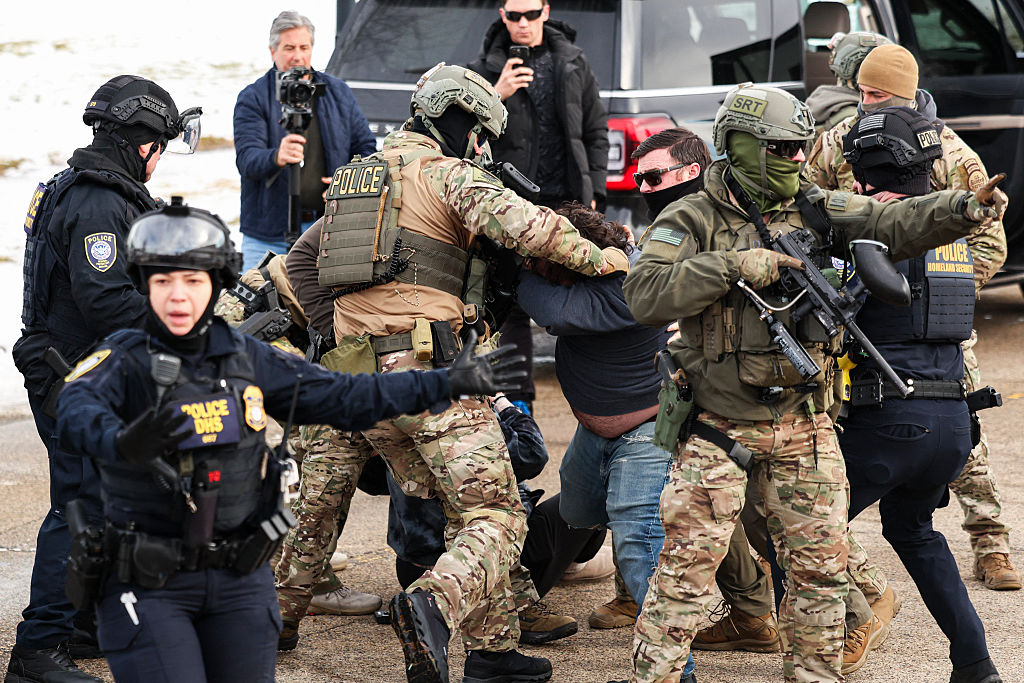
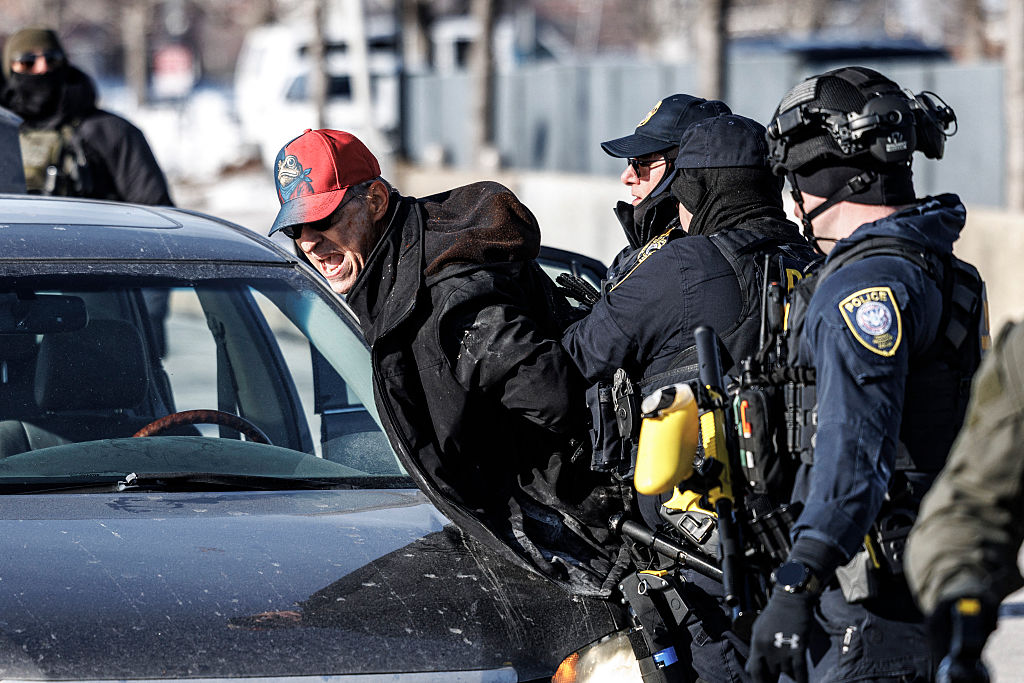
In the wake of Immigration and Customs Enforcement (ICE) and other Department of Homeland Security (DHS) agents’ increasingly lawless and violent rampage through Minneapolis, those defending their abuses have claimed they are rooted in a respect for law enforcement. To second-guess ICE agent Jonathan Ross’s murder of Renee Good or the Border Patrol agents who murdered Alex Pretti, or to criticize federal agents’ behavior more generally, they argue, is tantamount to reviving the “defund the police” movement. And a fair and judicious review of the footage of Good’s killing specifically shows that Ross was perfectly justified in using deadly force.
All of this is pretty impossible to square with anyone who has used their own eyes to watch the videos of the killings of each. But it’s also hard to square with the fact that some of the harshest criticisms of not just Good’s and Pretti’s murders but DHS agents’ tactics over the past year more broadly have often come from former and current law enforcement officers, including former DHS personnel themselves.
Craig McQueen, a former assistant chief of police with the Miami Police Department, seemed astonished that Pretti would even be pepper sprayed for trying to help a woman who had been pushed over, let alone shot, calling him “basically a helpless man” at the time he was killed and declaring it “totally unjustified.”
In the wake of Pretti’s killing, numerous Trump officials and right-wing commentators have charged that merely the fact that he had a pistol on him at the time — for which Pretti had a concealed carry permit — made it justifiable for DHS agents to shoot him. Several actual former law enforcement officers disagreed.
A former Green Bay Police Department district captain called the shooting “unwarranted” and that you can’t shoot him just because it’s in his holster”; “otherwise, there’d be a lot of people [who] would get shot.”
Two former policemen, one of whom later worked as a training instructor, told the New York Times it was “disturbing” and questioned why Pretti was shot after the gun he was legally permitted to carry was taken. “It’s just utterly ridiculous to suggest that just because someone has a weapon on them, that that justifies the use of deadly force,” one of the officers told the paper.
Maybe this is to be expected. The killing of Pretti, prone, face down, surrounded by roughly half a dozen agents, was caught on film from so many angles and so clearly unjustified that hardly anyone can seriously defend it — which is probably why so many Republicans have, this time, not even tried to justify it, and the Trump administration has now done a public U-turn.
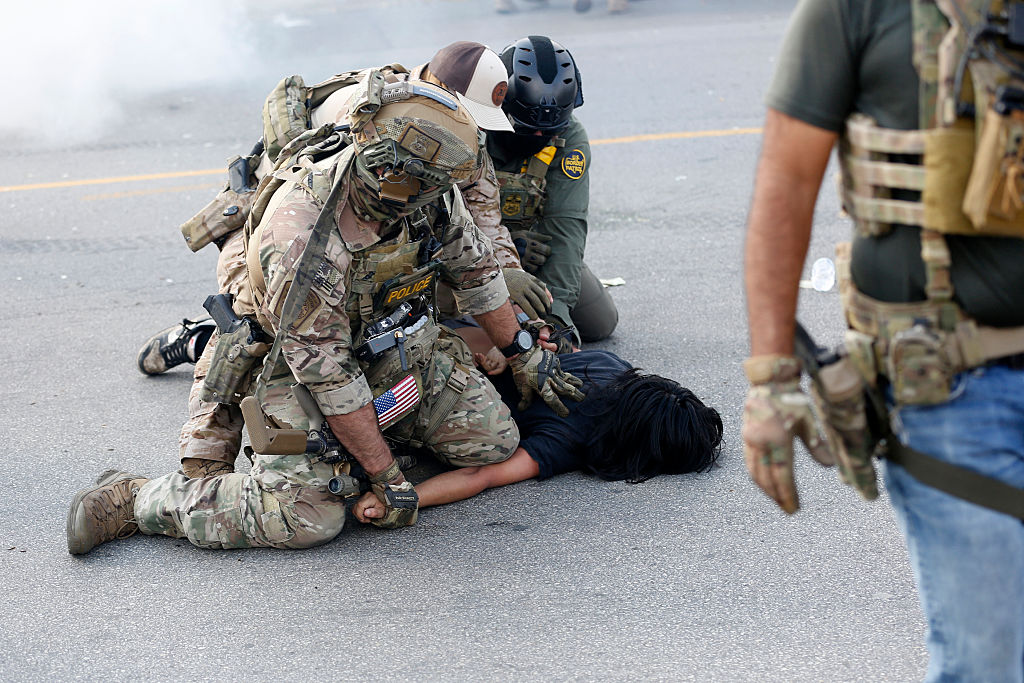
But voices from law enforcement were just as across-the-board critical of the Good murder, which many have insisted is filled with ambiguities and was even justified.
Shortly after she was killed, Minneapolis police chief Brian O’Hara was scathingly critical in a conversation with the New York Times’s Michael Barbaro about the decisions Ross made that led him to kill Good, whose murder he said “was predictable and preventable.”
“The No. 1 is you don’t place yourself in the path of the vehicle. That’s like Traffic Stop 101,” O’Hara said, before laying out the various things officers do to de-escalate and act professionally, like introducing themselves to a driver and explaining why they’re being stopped. “I didn’t see any of that,” he said.
O’Hara was also more broadly critical of DHS tactics in Minneapolis this year, complaining that local police were struggling to deal with constant 911 calls about ICE actions, including abandoned cars that agents at times left to roll uncontrollably down the road. ICE and other DHS agents, he said, had eroded any public trust his department had worked hard to win back after 2020.
It echoes the complaints shortly after from a group of Minnesota law enforcement leaders, led by Brooklyn Park police chief Mark Bruley, who alleged that their own off-duty officers were being racially profiled, treated aggressively, and even had guns drawn on them by federal agents. One local police chief called federal agents’ behavior “not just only wrong, but illegal.”
“It has to stop,” Burley said.
O’Hara was by no means alone in his assessment of Good’s killing. Going frame by frame through the original video, former ICE agent Eric Balliet — who spent twenty-five years in law enforcement and who investigated use-of-force misconduct for the agency until last year — likewise criticized Ross for getting in the way of the car and questioned whether he really had justification to shoot Good.
“The first thing you do is do not put yourself in the position where you are in danger. . . . If you have the choice not to be in front of a car that’s moving, don’t,” commented former US Capitol Police chief Tom Manger.
A retired St Paul police officer similarly called that decision “both tactically and legally unwise,” and said Ross’s actions made him wonder if ICE agents “possess even a rudimentary understanding of basic policing tactics or the legal principles governing them.”
“It was really an unnecessary shooting,” a former Florida police officer told the Washington Post a few days after it happened, one of several former law enforcement officials who criticized Ross in statements to the paper for endangering himself, escalating the situation, and shooting into a moving vehicle. “If you’ve got time to shoot, you’ve got time to get out of the way, which we saw in this case. The guy was clearly able to avoid being impacted by the car.”
It’s not just former law enforcement but even current and former ICE and other DHS personnel who expressed disquiet about the shooting. The day of, an unnamed “senior” DHS official told NBC News that agents are trained not to do either of the things Ross did, namely, to get in front of a vehicle and to fire into it; a retired ICE agent likewise questioned Ross’s decision to put himself in danger. A day later, multiple current and former DHS officials questioned his conduct to CNN.
After days went by and the dust settled, one former ICE agent with twenty-five years of experience told Time that they were “embarrassed” and that “the majority of my colleagues feel the same way,” while a current ICE agent said that the video footage was “very problematic for” Ross’s claim of self-defense. Commenting on the incident, a former ICE chief of staff and Customs and Border Protection (CBP) counterterrorism official said that immigration enforcement had “drifted away from its core purpose” and had become “politicized, disconnected from local realities, and increasingly dangerous for everyone involved.”
“They murdered her, plain and simple. That is all there is to it,” the former deputy chief counsel for ICE’s Dallas field office told Mother Jones.
This frustration has now migrated beyond Minnesota. After ICE agents arrested a corrections officer in Maine who they falsely accused of being undocumented, the local county sheriff slammed the arrest as “bush-league policing” and accused ICE of having “moved the goal posts” and now treating anyone who’s not “a card-carrying US citizen” as if they’re “illegal.”
Before Minneapolis
Criticism of DHS agents from current and former law enforcement was already mounting before the murders in Minneapolis.
Back in October, Thomas Mills, the chief of police in the Chicago suburb of Broadview, bitterly criticized DHS’s tactics at the local ICE detention center in a sworn statement. Agents’ use of chemical weapons “has often been arbitrary and indiscriminate” and “unlike anything I have seen before,” he said, noting that agents’ appearance and behavior was counterproductive to what they were in theory trying to do. When agents in masks and camouflage tactical gear approached, Mills said, “the tone of the crowd of protesters changed” and “grew louder and began to press closer to the building,” calming down only once the agents retreated back into the building.

Commenting on a now-infamous September ICE raid on Chicago’s south side — in which federal agents indiscriminately kicked down doors, laid waste to the apartments inside, and dragged their occupants out and zip-tied them, children included — retired St Louis police lieutenant Ray Rice called it a “betrayal of constitutional norms.” The group Rice heads — the Ethical Society of Police, founded in 1972 by black police officers trying to push back against racism — put out a statement together with the National Association of Black Law Enforcement Officers that declared the raid “state violence.”
These weren’t the only law enforcement groups that had harsh words for DHS’s behavior. Only a few days before the raid, the International Association of Chiefs of Police warned that agents’ masks and refusal to identify themselves “can create confusion, fear, and mistrust.”
This was a common complaint from law enforcement officials. “I do have a problem with any current police officer who thinks dressing up like SEAL Team Six and putting a mask on to deal with the public is the right way to do police work. They should not be doing that. It’s intimidating,” former King County sheriff John Urquhart told a Seattle radio show at this same time, complaining that it was making the police’s job harder and eroding their trust with immigrant communities.
“This is all about intimidation” was the similar conclusion of the former second-highest-ranking official at the Drug Enforcement Administration. A former assistant director of the US Bureau of Alcohol, Tobacco, Firearms and Explosives likewise opined that he had “never known law enforcement . . . to wear masks.”
“My perception is that they know they are operating on the fringe of the law and ashamed of their actions,” commented a former military police officer who likewise questioned agents’ use of masks, calling their “questionable apprehensions/detentions” the actions of “cowards and bullies.”
“We don’t need, nor do we want secret police here,” wrote a retired three-decade-long former law enforcement officer, charging that the only officers who would cover their faces “are either mercenaries, cowards, those who simply look to intimidate the public, those that are perhaps ashamed of how the job is being done, and those who might consider abusing their authority.” Diane Goldstein, a retired lieutenant who spent twenty-one years on the force, described ICE’s behavior as “lawlessness” and an “authoritarian spectacle” and said their arrests “more closely resemble kidnappings.”
Former DHS personnel were just as scathing about their agencies’ operations before Good’s murder. Included in US District Court judge Sara Ellis’s November 2025 ruling barring agents’ use of force against protesters was expert testimony from Gil Kerlikowske, a forty-seven-year-long law enforcement veteran who was once both the Seattle chief of police and the commissioner of CBP. Kerlikowske concluded, similar to Mills, that agents were “deploying force that exceeds a legitimate law enforcement purpose,” often violating their own guidelines in the process, and that this was “highly ineffective and often counterproductive in calming unrest.”

Balliet, the former ICE use-of-force investigator who reviewed the Good shooting for CBS, had been critical of ICE’s tactics before that murder. Last year, looking at the flood of videos of DHS agents mistreating protesters, he told the news outlet that “this isn’t policing and law enforcement as I practiced it for twenty-five years” and that “they are elevating the force to a degree that is excessive,” with “oversight and justification for the use of force” seemingly “absent across the board.” Commenting on a video late last year of an ICE agent manhandling a woman, Balliet said that in all the years he had “arrested dozens upon dozens of human traffickers, human smugglers, child molesters” through his career, he had “never dragged a suspect one-handed across a street.”
After an agent who was filmed violently assaulting the wife of a detainee was quickly returned to the job with no punishment, a former ICE chief of staff under Joe Biden called it part of a “larger systemic issue of how law enforcement is being hyper-politicized.” Barack Obama’s ICE director charged that “the ultimate objective [of the operations] is not legitimate law enforcement, it is to scare people to death,” and that “it has never been done in this way before.” A former ICE deportation officer has said that during her time there, agents didn’t wear masks or pick people up at random, and always carried credentials and identified themselves, but that now it seems “the gloves are off and they’re doing what they want.”