



KAREN SHAMES Poor Cousin At Family Gathering
KAREN SHAMES Poor Cousin At Family Gathering
PLOT
At a family dinner held in honor of her late father Malcolm, wealthy and entitled CEO Kiana Thompson turns what should be a moment of remembrance into a cruel power display. She openly humiliates her younger brother Daniel by snatching his food and repeatedly targets her struggling cousin Elijah, mocking his finances, freelancing career, and worth—implying that he’s only here for a free meal. Despite constant pushback from Maya, Aunt Priscilla, and other relatives who remind her that this is a memorial, not a roast, Kiana refuses to stop. She frames her insults as “honesty,” boasts about her role as the new CEO of the Thompson Hospitality Group, and dismisses compassion as weakness. She even questions her late father’s will, ridiculing the fact that Elijah inherited the ski resort, suggesting he didn’t deserve it. As tensions rise, Uncle Wayne attempts to redirect the evening by honoring his brother’s legacy—how he built the family empire from nothing. Kiana hijacks the toast yet again, taking a final jab at relatives she views as “hanging on by scraps.” Her relentless shaming ultimately drives Elijah to leave the table in humiliation and discomfort. Maya sarcastically congratulates and finally calls Kiana out for weaponizing a family gathering, exposing how her wealth and title have stripped her of her empathy. The dinner ends fractured and bitter, revealing that while Kiana may hold power and money, she lacks the decency, humility, and humanity her father once stood for.
Maya pulls Elijah aside and complains that she was actually hungry, asking why he always leaves before the food gets good. Elijah smirks and replies that if by “good” she means overcooked and unbearably tense, then he has no regrets. Maya agrees, saying Thompson dinners are always the same—polished on the surface, yet empty underneath. Elijah sighs and admits he knows Kiana is grieving, suggesting maybe they should ease up on her for now. Maya immediately shuts that down, rolling her eyes and mocking the family’s usual excuses: “Give her time,” “Let her have this,” “It’s just the grief talking.” She insists this isn’t grief—it’s greed dressed up in Gucci. She adds that Uncle Malcolm would have despised Kiana’s behavior, especially the way she acts like she personally laid every brick of the hotel empire. Elijah grows quiet and recalls something Malcolm once told him: great service isn’t about marble floors—it’s about how you treat people. Maya softens and admits Malcolm always had a gift for seeing potential where others didn’t. She says he truly saw Elijah, maybe more than anyone else in the family ever did. Elijah dryly congratulates her and mutters that Kiana is already crowning herself queen. Maya snorts and says if Kiana’s the queen, then poor Daniel has been reduced to the court jester. He asks where that leaves him. Maya grins and tells him he’s the ghost in the corner—the one who knows how the family really runs. She jokes that most ghosts stay silent. Maya smiles back and quips saying that most ghosts find the right people to haunt.
After dinner, Kiana sits down with Daniel and Elijah to review the company’s finances. She coldly announces that by the next quarter, more than half of the hotel managers will be let go. According to her, the staff has grown lazy, slow, and stuck in outdated habits. Daniel questions her about loyalty, reminding her that many of these managers have been with the company for years. Kiana dismisses him outright, calling them useless and insisting she needs people who can fill rooms and slash costs. Elijah pushes back, pointing out that these are the same employees who helped build the hotels alongside their late father, Malcolm. Kiana scoffs and reframes it as “reshuffling,” saying modernization requires tough decisions and that sentimentality has no place in leadership. Her brother snaps, accusing her of calling theft a strategy and stripping their father’s company in the name of progress. She fires back that Malcolm wanted action—and she’s delivering results. Kiana then reminds Daniel that their father trusted her to lead and tells him to calm down. He laughs bitterly, calling it a warped fairy tale. He accuses her of weaponizing their father’s death to seize the CEO position while pushing him aside. Kiana coldly responds that he’s not cut out for leadership, calling him too emotional to run a company. Elijah steps in, urging them to stop. He says this isn’t just about inheritance—it’s about the company’s reputation. Kiana waves him off, mocking his “moral compass routine” and asking whether or not he’s even on the payroll. She cruelly adds that Malcolm keeping him around was nothing more than a charity project to make himself feel generous. Daniel explodes, telling her she’s crossed the line. Kiana smirks and taunts him, asking if he’s going to cry about it like the immature boy he’s always been. After that, he drops a bomb and slides documents across the table—bank stubs showing forged signatures, fake vendors, and money rerouted to shell accounts. He explains that the so-called “renovation expenses” all trace back to Kiana. She barely reacts, brushing it off and claims that Daniel doesn’t understand corporate accounting. Elijah calmly points out that auditors already have access to the books—and by tomorrow morning, they’ll see everything if they haven’t already. Still unfazed, Kiana asks if paperwork is supposed to scare her. Daniel warns her that this isn’t just mismanagement—it’s a white-collar crime. He says he doesn’t want the business to collapse, because it would devastate the employees, the board, and the markets. Elijah suggests a solution: move the money back tonight, stabilize the accounts, and keep the hotel running so the staff won’t have to suffer for Kiana’s recklessness. She refuses flatly and accuses them of trying to undermine her authority and declares she won’t let either of them touch a single cent. Elijah warns her to stop posturing and reminds her this isn’t a game—they’re running out of time. Kiana straightens in her chair and asserts her dominance, asking if they even know who they’re dealing with. Daniel meets her stare and quietly asks the same question.
Just then, police officers enter the house and order Kiana, Daniel, and Elijah to stay where they are. One officer announces that they are executing a search-and-seizure warrant for fraud and embezzlement. Kiana immediately steps forward, furious, demanding to know why the police are interrupting a family matter. A female officer calmly shuts her down, stating that there are federal warrants tied directly to Kiana. She explains that investigators uncovered evidence showing government development funds—meant for Thompson Hospitality projects—were transferred into her personal bank accounts. Kiana scoffs and calls the accusation absurd, insisting her late father, Malcolm, built the company and accusing the authorities of turning his death into a spectacle. The officer doesn’t budge and informs them that they will be seizing all electronic devices, financial records, safes, and anything tied to executive operations. Kiana smirks and claims they have no proof. The officer counters that millions in government subsidy money earmarked for new hotel developments were traced directly to accounts under Kiana’s name. Elijah looks stunned. Kiana dismisses it as “accounting entries” and arrogantly lectures the officers about how business works, calling it nothing more than logged transactions. Daniel snaps at her to watch her mouth, but she coldly tells him to stay out of it. Kiana then demands to know who authorized the raid and threatens to call her attorney general contact, smugly saying they’ll all lose their jobs. The female officer replies evenly that the operation was authorized by the attorney general. Elijah urges the officers to take everything they need. Kiana whips around and tells him he doesn’t speak for her. Daniel explodes, accusing her of using their father’s legacy as a personal ATM and says she didn’t just inherit rot—she created it and watered it herself. The officer requests their personal phones and laptops. Kiana refuses outright, asking if the officer has lost her mind. The officer warns her that obstruction will result in additional charges. Elijah begs Kiana to comply, telling her this is her chance to cooperate and possibly reduce her sentence. She laughs bitterly, accusing them of trying to destroy her and claiming the whole house will burn with her. Daniel fires back that he and Elijah will survive—because they didn’t steal from the people who trusted them. The officers place Kiana under temporary arrest for questioning. She protests loudly, accusing them of disrespecting her father’s memorial and demanding decency. The officer calmly reads her rights, stating that probable cause doesn’t pause for sentiment. Kiana turns on Daniel and Elijah, accusing them of abandoning her and dragging her through the mud, insisting this is personal. Daniel corrects her—this isn’t personal, it’s theft. Theft from the employees, the board, and their father’s life’s work. As she’s escorted out, Kiana sneers that the headlines will love this and promises that this isn’t over. Daniel responds dryly that he hopes it lasts a very long time and sarcastically adds that he’ll make sure her jail cell has cable and all the comforts she’s used to. After the police leave, the house falls quiet. Daniel tells Elijah he did what he had to do. He asks if he’s sure about this. He says he is—this was for the company and for his father. Elijah promises to push the board to appoint Daniel as interim CEO. Daniel refuses, saying the role belongs to Elijah. He tells him this is his legacy now—and they both know it. Moved, Elijah asks how he can repay him. Daniel smirks and says he can start by buying him dinner, joking that he barely ate anything off a prom queen’s menu.
Later, Elijah visits Kiana in her jail cell. She looks up with a bitter smirk and immediately asks if he came to gloat. He shakes his head and tells her no and explains that he came because, before the lawyers and court dates take over, he still believes family should at least say hello. Kiana scoffs, calling it noble, and asks whether Daniel sent him—whether this is part of making sure the “villain” looks properly framed for her upcoming court appearance. She adds that maybe he just wanted to see her at her lowest. Elijah calmly tells her he came on his own. He says he doesn’t hate her, despite everything. That only makes her laugh. She mocks him, calling him a hero, and asks if this is the moment where he gets to stand above her and feel superior. Elijah tells her quietly that he doesn’t think he’s better than her. He says the difference is that he’s free—free to walk away, free to choose what kind of person he wants to be. Kiana has no comeback as he stands, gives her one last look, and walks out. She watches him leave in irritation to the sound of the door closing echoing through the cell.
Remembering the Real Victim in the Karen Read Case, My Friend John O’Keefe
Karen Read, the Massachusetts woman accused of killing her Boston Police officer boyfriend, has been painted as a scapegoat, a symbol, and a true-crime celebrity. But what about the man who died—and the people closest to him?
By Tara Kerrigan· 4/12/2024, 10:30 a.m.
Get a compelling long read and must-have lifestyle tips in your inbox every Sunday morning — great with coffee!
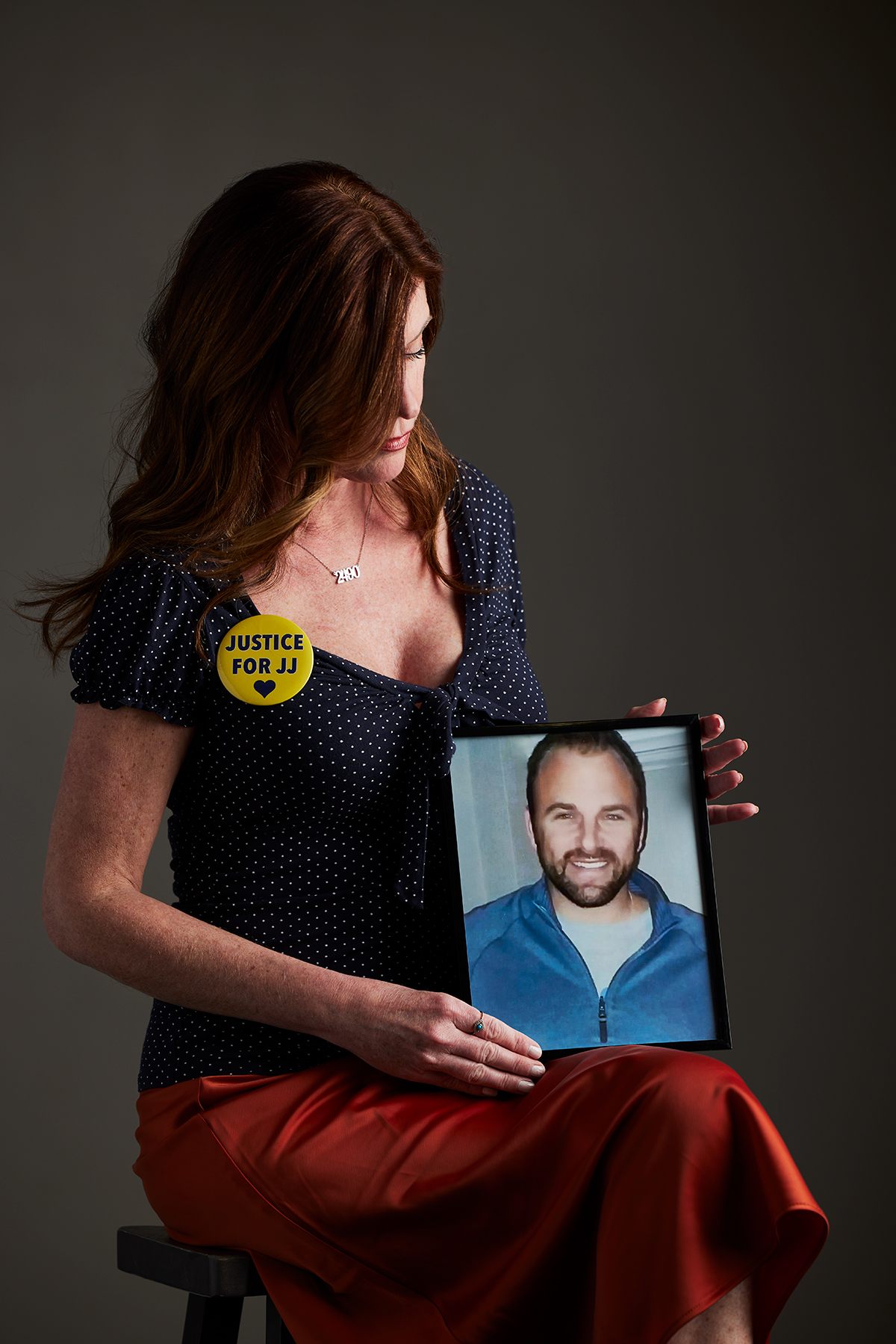
The author, with a portrait of her good friend, John O’Keefe.
My phone was still on silent when I woke the morning of January 30, 2022, to four missed calls and a text from a friend that read, “Call me when you get up. I think something happened to John.” I dialed her number. “John who?” I asked as soon as she answered. “Your John. John O’Keefe,” she said, explaining that she had seen a tribute to John on Facebook that indicated he had passed away.
While technically my ex-boyfriend, John was so much more than that. We met in 2001 and had a big love that evolved into a friendship spanning more than 20 years. We had seen each other through some hard times. We had a special connection.
I immediately hung up and called John’s cell—I knew he would answer, explain the mix-up, and we’d laugh about it. At least, that’s what I told myself. But John didn’t answer; instead, the phone went straight to voicemail. I tried him again. Voicemail.
I learned later that John’s brother, Paul, had been awakened the previous morning by a call from their mother relaying that John had been found in a snowbank. Paul was the first to arrive at the hospital, where he sat for 45 minutes alone while doctors tried to warm John up. When his parents arrived, all three were escorted into a small room by a hospital employee and waited for a doctor and nurse to come in. “They were still wearing masks,” Paul told me. “But I could tell by the look in their eyes.” While the nightmare began differently for each of John’s loved ones, it ended the same for all of us. He was gone.
John’s wake was an emotionally agonizing yet poignant tribute to a man defined by his deeds and a life rich with purpose as a parent and a 16-year veteran of the Boston Police Department. Given the magnitude of the turnout, the gathering was held inside the church of St. Francis of Assisi in his hometown of Braintree. More than a thousand people waited patiently in the biting rawness of that frosty February day to pay their respects. Officers from across the country, wearing pristine uniforms and expressions of devastation, formed a procession led by Boston Mayor Michelle Wu.
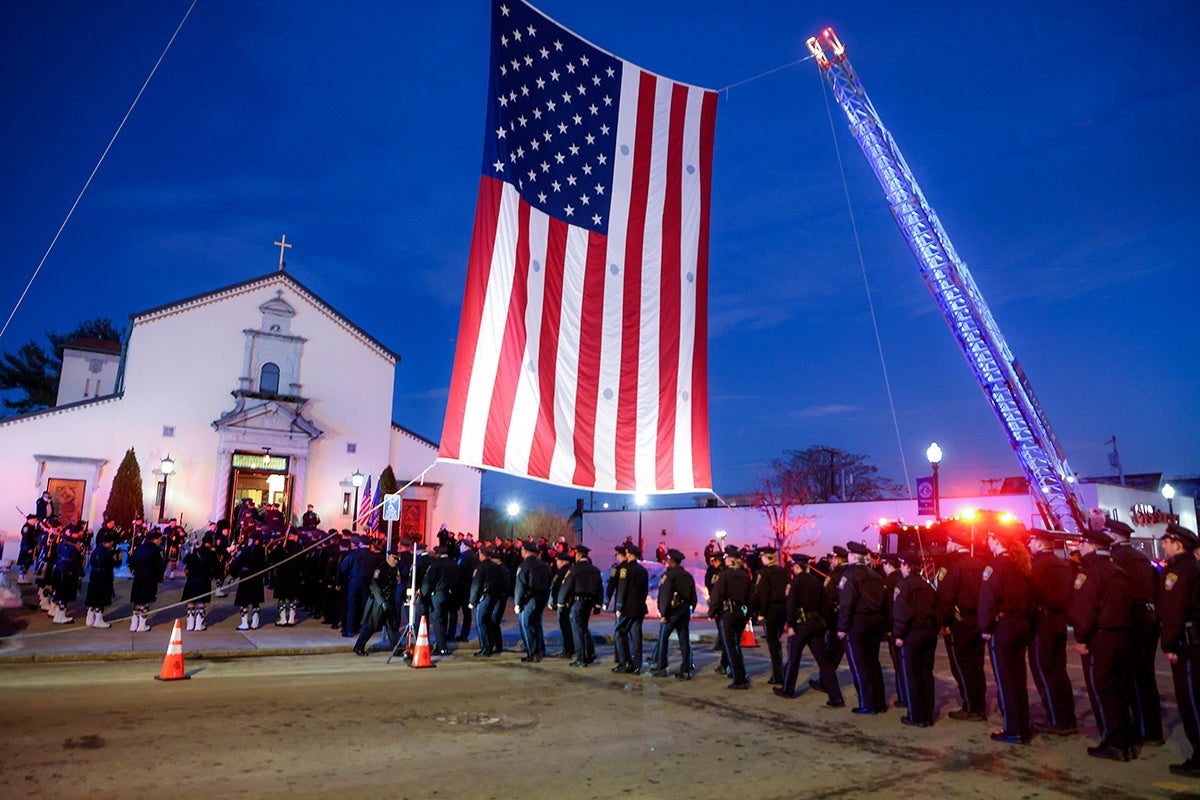
The procession outside Braintree’s St. Francis of Assisi Church in remembrance of Boston Police officer John O’Keefe, III on Feb. 6, 2022. / Photo by Matthew J. Lee/The Boston Globe via Getty Images
As I inched closer toward the blue coffin, my trembling legs turned to lead. I was not ready to face this reality, the finality of this moment with John. Adorned in his police uniform, he was as startlingly handsome in death as he had been in life.
If the wake felt like floating through a bad dream, the funeral the next day proved even more surreal. Among the parishioners, a distinct cluster of faces were painfully familiar. We shared nods of comradery from across the pews. We had been here before. In 2013, John had lost his beloved sister, Kristen, to a brain tumor, followed by the suicide of his close friend and fellow officer just eight days later. Two months after that, his sister’s husband died of a heart attack. As the procession approached, memories of the prior funerals came rushing back to me. I recalled standing at the end of the pew, as I did now, when John reached out to squeeze my hand. Now, it was John in the coffin, which happened to pause right in front of me for the draping of the pall.
After the death of his sister and brother-in-law, John made the selfless decision to abandon the familiar bachelor life he had known to embrace the role of a single parent to his six-year-old niece and three-year-old nephew. He traded the city for suburban life in Canton and transferred to a safer position for the sake of the children, who had already lost so much.
The children bestowed upon John the endearing nickname “JJ” and renewed his sense of hope when life seemed too bleak to carry on. It would be those children who would lose a third parent on the night John died.
During the service, Paul remembered his brother in a moving eulogy that evoked both laughter and tears. He spoke of their childhood, their closeness, and how John never left their sister Kristen’s side during her battle with cancer. Praising John for providing a home full of love for her children, he concluded with the haunting words, “We’ll take it from here.” Those were the very same words John said when he eulogized his sister nine years prior.
One of the most touching tributes that day was when hundreds of strangers, with their hands on their hearts and blue ribbons affixed to their clothing, lined the sidewalks along the funeral route from St. Francis church to the Blue Hill Cemetery in a demonstration of sorrow and solidarity with John’s family. As we basked in this outpouring of kindness, none of us could have foreseen that John’s parents and their last surviving child, Paul, were on the verge of being sucked into a toxic, conspiracy-fueled drama that would steal the solace they had found in the early days of their loss.
The Karen Read Case in Canton:
The Killing That Tore a Town Apart
Just a week before the funeral, prosecutors had charged John’s girlfriend, Karen Read, with vehicular homicide and manslaughter, later changing the charges to second-degree murder. Investigators concluded that she was intoxicated when she backed over John with her car after dropping him off at a late-night gathering, and then left him to die in the cold. His family also believed that Read was to blame.
What John’s family considered to be an open-and-shut case, though, was about to become anything but. In September 2022, Los Angeles–based criminal defense attorney Alan Jackson, who defended Kevin Spacey and Harvey Weinstein in sexual assault cases and is known for his flair in the courtroom, joined Read’s legal team. I sat with John’s family and friends in disbelief as Jackson transformed hearings into what felt like the set of a Hollywood whodunit, arguing that Read was framed. He told of extravagant theories that I and John’s family believe directly contradicted the facts of the case.
Still, the worst was yet to unfold outside the courtroom walls. A case that rightfully belonged within the confines of the legal system was soon converted into what felt to me and John’s family like an unofficial and unregulated trial playing out in the streets. After a blogger named Aidan Kearney (a.k.a. Turtleboy) began to write about the case, maintaining that Read was innocent and being framed, large numbers of his readers showed up alongside him at court hearings shouting and wearing shirts that read, “Free Karen Read.” Sensitive to the O’Keefe family’s suffering, these people were not: One of Read’s supporters used the online pseudonym “O’Keefe’s Frozen Corpse.” At a Halloween party to raise money for Read’s legal defense, one attendee used makeup to recreate the same wounds O’Keefe had on his arm. The cake at the party appeared to be decorated like blood-soaked snow.
https://www.youtube.com/embed/1emYlW5ovJY?si=sYLz4tR6aFXGeLeV
Scenes from the “Free Karen Read” Halloween fundraiser.
I witnessed this scenario play out at a hearing on July 25, 2023. When Read showed up, her supporters showered her with a celebrity’s welcome. When John’s family arrived afterward, they asked court officers to let them use an alternative entrance to avoid walking through the echo of cheers for the woman accused of killing their son. The court denied the request, and when the victim’s loved ones walked into the courthouse, the crowd erupted into jeers and taunts.
Dazed, I gathered with John’s family in the hall. While most of us were visibly shaken, Paul stayed remarkably calm. He stood expressionless, watching the crowd through the door, hands in his pockets, exuding a quiet strength that reminded me of his brother.
After the hearing, Read’s supporters once again shouted insults at us. Someone who Paul recognized as a close friend of Read’s parents even hollered the phrase “cop killer” at him. While completely illogical—no one seems to believe that John’s own family murdered him—this is what Read’s supporters label anyone who doesn’t believe she is innocent, and it’s a term his family and I have had to desensitize ourselves to. I once asked Paul how he managed to show such remarkable restraint while under attack by Read supporters. “They’re misinformed. Misguided. So I just don’t engage,” he told me.
At a subsequent hearing, the pro-Read crowd—who seemed to keep increasing in number—once again harassed me, Paul, and other friends of John’s who had shown up to support the family. The enraged crowd chanted “Shame on you” in unison as we entered the courthouse. After the hearing, court officers warned us to refrain from exiting immediately “for our own safety.” We waited, only to find the crowd was waiting, too. We needed the protection of the state police to find our way safely to our cars, as the mob followed us, screaming “cop killers.”
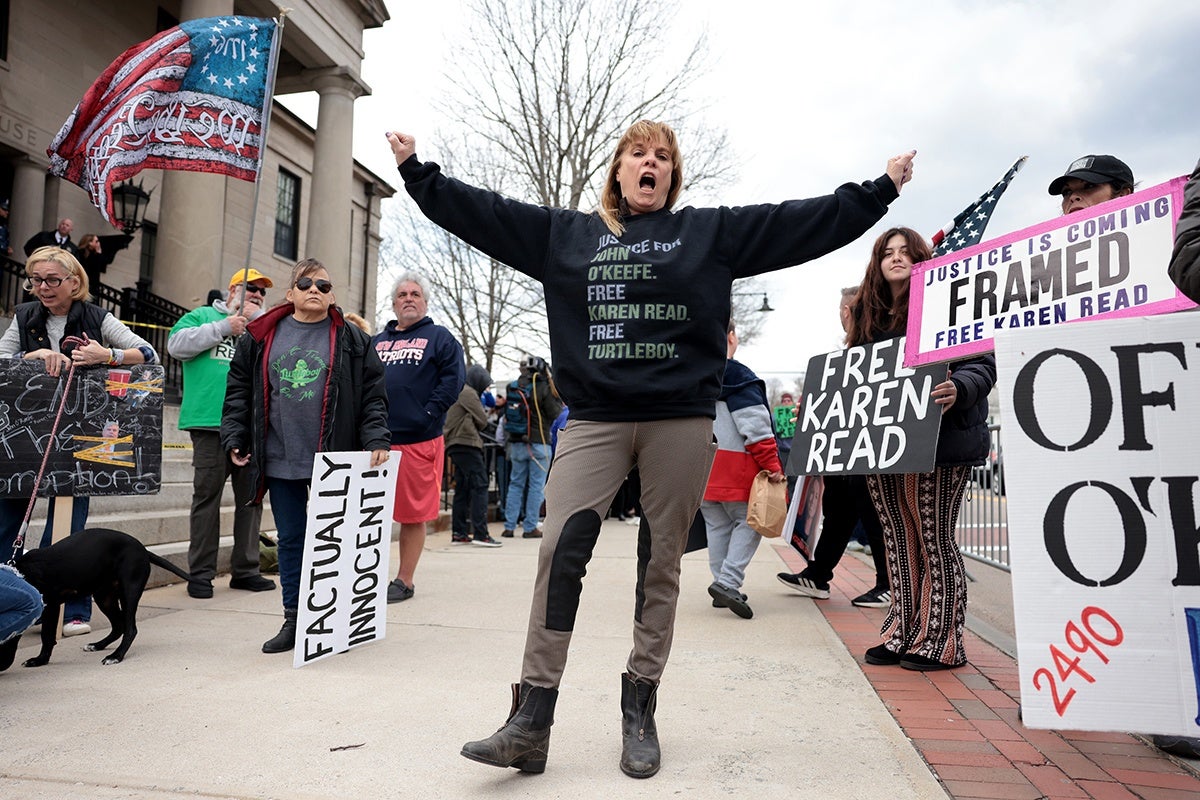
Karen Read supporters protest outside a Dedham courthouse before one of Read’s Norfolk Superior Court appearances. / Photo by Jessica Rinaldi/The Boston Globe via Getty Images
Afterward, I reconvened with John’s friends and family at a restaurant far from the chaos to grapple with the surreal events that had just unfolded. Someone remarked that the scene was like something you’d see in a horror movie.
Those words brought back memories of John in the months following the loss of his sister, his brother-in-law, and his friend—a time when it seemed as though the light in his eyes had all but been extinguished. When people asked him how he was coping, he’d answer that he’d tell himself that none of it was real. “It’s only a movie,” I remember he used to say. “It’s only a movie.”
Making a difficult time even more harrowing, horrific pictures of John began to appear online. In one split-screen image, John’s smiling face was juxtaposed with snow drenched in his blood. One of the most painful moments for John’s family was when Turtleboy’s blog published leaked photos from the autopsy report, allowing morbidly curious readers to gawk at one of John’s most intimate and vulnerable moments.
Meanwhile, Read’s supporters became a fixture at every hearing as the case began garnering national headlines, with Read’s images splashed across media outlets—only now, she was depicted as the victim. The larger the crowds and the wider the media coverage, the more it seemed as though John’s legacy was fading into obscurity while the public celebrated the supposed innocence of the woman accused of murdering him. That, for the family, has been the most enduring pain of all. “In all of this chaos, it feels like John’s being forgotten,” Paul recently said to me. “And the person who stands accused of killing my brother is now being treated like the victim.”
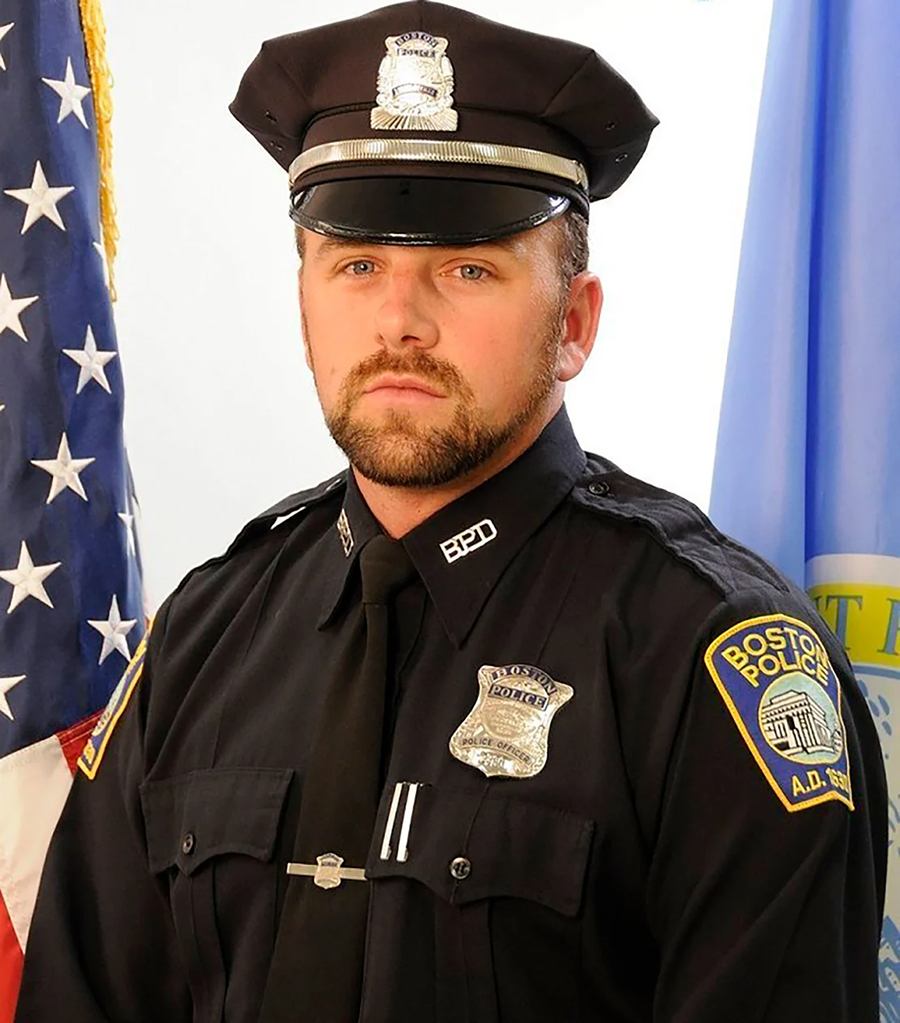
John O’Keefe in uniform. / Courtesy of the Boston Police Department
As I write this in the run-up to Read’s trial, which at presstime was set to begin in mid-April, I can sense the frustration among John’s family and friends. We’ve grown tired of playing prosecutor outside of court. We’ve been forced to continuously dispel the defense team’s claims with concrete facts to strangers and even friends. We’ve watched expressions shift when we’ve succinctly explained the impossibility of what Read’s attorneys and supporters claim: that John was attacked by acquaintances (and their family dog) who then dumped John outside to die with no concern for human life (or legal culpability), before returning to a house party and somehow managing to swear an unbreakable oath of silence with nine other guests, who willingly obliged to let an innocent man freeze to death in a blizzard after a merciless beating, thereby becoming accomplices to murder themselves. To pull this off, we explain over and over again, the assailants would have needed the participation of numerous collaborators both during and after the incident, becoming one of the more intricately complex and audacious cover-ups in recent history, concocted spontaneously amid a night of revelry and drinking.
My guess is that only a handful of the many people following this case have actually watched the hearings, during which prosecutor Adam Lally has consistently, calmly, and incontrovertibly dismantled each fragment of Read’s defense. The public doesn’t seem to take the time to read the actual court documents. The idea of a conspiracy is apparently far more interesting than the facts.
Over time, though, our crusade to spread the truth has taken its toll on all of us. It’s robbed us of moments we could have spent focusing on John’s memory and keeping it alive. So we make it a point to share remembrances of John with one another. We text each other photos of John throughout the years and reminisce in person when we can.
Recently, I was standing in John’s kitchen with his mother, Peg, looking at photos on the refrigerator of John and the kids. It brought me back to a day when John called me not long after his brother-in-law had died. John told me he was coming over because he had something he wanted to tell me. When he arrived, he plopped down on my couch, took a breath, and said, “I’m taking the kids. I think people doubt I will see it through because I’m a bachelor, but I’m going to raise them as my own.” We talked about what life would look like. Then he asked two simple questions: “So what do I feed them, and what time do they go to bed?” He laughed heartily at himself before saying, “Seriously, though, let’s hear more about this potty-training stuff.”
In the years that followed, it was a joy and an honor to watch John transform into a parent. He relished taking his girl to dance recitals and attending his boy’s baseball games. Building a home for and with the children reignited the light in his eyes. It was their love that brought John back to life after the losses he suffered—before his own life was violently snatched away.
Today, there is a core group of us “John supporters” who have attended every hearing and are determined to love and support his family as he would have done for us. At each court date, we brace ourselves for the inevitable harassment by the many Read supporters who never knew John and don’t even know Read. In the early days, we were shaken and appalled. Yet as the trial approaches, we’re no longer rattled. Empowered by the truth, we march past the crowd with our heads held high as they shout expletives at us. We are confident that the defense team’s case is built on a house of cards, and all it will take is a gust of truth to knock it down.
On occasion, after a court hearing, a small group of John’s friends will go out for a drink with Paul. We toast to John, and to justice. Paul places a Bud Light on the bar for John every time. Others, like me, have begun adopting this small tribute, too. We share memories and stories of better days gone by. Paul imitates John’s signature walk, and we all laugh because he always nails it. Laughter gives way to tears, and we take turns falling apart, hugging through the moment.
One day, a group of us visited John’s grave, taking turns to say our prayers. I watched Paul place one hand on the headstone of his brother and the other on the headstone of his sister. He crouched between them, lowering his head. He wasn’t just praying. He was reestablishing the connection between the three siblings, who shared not just a name but a genuine friendship. It was heartbreaking to see. “We were supposed to grow old together,” Paul said. “Watch our children grow, our grandchildren grow. Take care of our parents.” When I asked what he misses most about John, he tells me, “I miss my other life partner. He was the pillar of this family.” Etched into his gravestone is the phrase John himself repeated after his own losses: “It’s only a movie.” It is something we all wish were true but know is not.
As I stood at the grave of one of the best humans I have ever known, I thought of the man behind the headlines. His smile, laugh, wit, kindness, and loyalty. His old-school manners and talent for photobombing that we all miss so much. I said a silent prayer to John and for John. I prayed for justice. I prayed this will be over soon so his family can finally begin a process that the circus around John’s death has denied them: the chance to grieve in peace.