

Minnesota
Lawyer representing Renee Good’s family speaks out
Antonio Romanucci condemned White House comments over Jan. 7 shooting
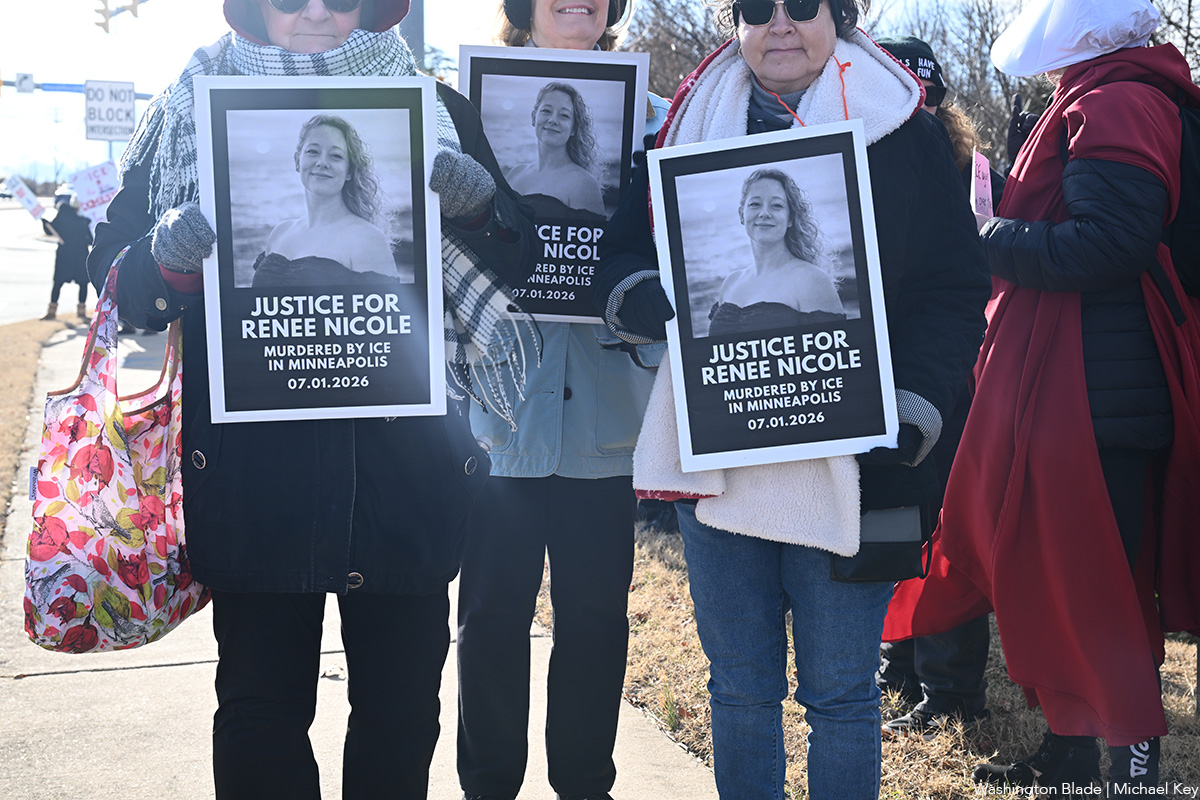
Protesters in Haymarket, Va., protest against U.S. Immigration and Customs Enforcement after an ICE agent shot Renee Good to death in Minneapolis. (Washington Blade photo by Michael Key)
A U.S. Immigration and Customs Enforcement agent shot and killed Renee Good in Minneapolis on Jan. 7 as she attempted to drive away from law enforcement during a protest.
Since Good’s killing, ICE has faced national backlash over the excessive use of deadly force, prompting the Trump-Vance administration to double down on escalating enforcement measures in cities across the country.
The Washington Blade spoke with Antonio Romanucci, the attorney representing Good’s family following her death.
Romanucci said that Jonathan Ross — the ICE agent seen on video shooting Good — acted in an antagonizing manner, escalated the encounter in violation of ICE directives, and has not been held accountable as ICE and other federal agents continue to “ramp up” operations in Minnesota.
A day before the fatal shooting, the Department of Homeland Security began what it described as the largest immigration enforcement operation ever carried out by the agency, according to DHS’s own X post.
That escalation, Romanucci said, is critical context in understanding how Good was shot and why, so far, the agent who killed her has faced no consequences for killing a queer mother as she attempted to disengage from a confrontation.
“You have to look at this in the totality of the circumstances … One of the first things we need to look at is what was the mission here to begin with — with ICE coming into Minneapolis,” Romanucci told the Blade. “We knew the mission was to get the worst of the worst, and that was defined as finding illegal immigrants who had felony convictions. When you look at what happened on Jan. 7 with Renee and Rebecca [Good, Renee’s wife], certainly that was far from their mission, wasn’t it? What they really did was they killed a good woman — someone who was a mother, a daughter, a sister, a committed companion, an animal lover.”
Romanucci said finding and charging those responsible for Good’s death is now the focus of his work with her family.
“What our mission is now is to ensure that we achieve transparency, accountability, and justice … We aim to get it in front of, hopefully, a judge or a jury one day to make that determination.”
Those are three things Homeland Security Secretary Kristi Noem and DHS has outright rejected while smearing Good in the official record — including accusing her of being a “domestic terrorist” without evidence and standing by Ross, who Noem said acted in self-defense.
The version of events advanced by Noem and ICE has been widely contradicted by the volume of video footage of the shooting circulating online. Multiple angles show Good’s Honda Pilot parked diagonally in the street alongside other protesters attempting to block ICE agents from entering Richard E. Green Central Park Elementary School.
The videos show ICE officers approaching Good’s vehicle and ordering her to “get out of the car.” She then puts the car in reverse, backs up briefly, shifts into drive, and steers to the right — away from the officers.
The abundance of video evidence directly contradicts statements made by President Donald Trump, Noem, and other administration officials in interviews following Good’s death.
“The video shows that Renee told Jonathan Ross that ‘I’m not mad at you,’ so we know that her state of mind was one of peace,” Romanucci said. “She steered the car away from where he was standing, and we know that he was standing in front of the car. Reasonable police practices say that you do not stand in front of the car when there’s a driver behind the wheel. When you leave yourself with only the ability to use deadly force as an option to escape, that is not a reasonable police practice.”
An autopsy commissioned by Good’s family further supports that account, finding that her injuries were consistent with being shot from the direction of someone driving away.
The autopsy found three gunshot wounds: one to Good’s left forearm, one that struck her right breast without piercing major organs, and a third that entered the left side of her head near the temple and exited on the right side.
Romanucci said Ross not only placed himself directly in harm’s way, but then used deadly force after creating the conditions he claimed justified it — a move that violates DHS and ICE policy, according to former Assistant Homeland Security Secretary Juliette Kayyem.
“As a general rule, police officers and law enforcement do not shoot into moving cars, do not put themselves in front of cars, because those are things that are easily de-escalated,” Kayyem told PBS in a Jan. 8 interview.
“When he put himself in a situation of danger, the only way that he could get out of danger is by shooting her, because he felt himself in peril,” Romanucci said. “That is not a reasonable police practice when you leave yourself with only the ability to use deadly force as an option. That’s what happened here. That’s why we believe, based on what we’ve seen, that this case is unlawful and unconstitutional.”
Romanucci said he was appalled by how Trump and Noem described Good following her death.
“I will never use those words in describing our client and a loved one,” he said. “Those words, in my opinion, certainly do not apply to her, and they never should apply to her. I think the words, when they were used to describe her, were nearly slanderous … Renee Good driving her SUV at two miles per hour away from an ICE agent to move down the street is not an act of domestic terrorism at all.”
He added that his office has taken steps to preserve evidence in anticipation of potential civil litigation, even as the Justice Department has declined to open an investigation.
“We did issue a letter of preservation to the Department of Justice, Department of Homeland Security, and other agencies to ensure that any evidence that’s in their possession be not destroyed or altered or modified,” Romanucci said. “We’ve heard Todd Blanche say just in the last couple of days that they don’t believe that they need to investigate at all. So we’re going to be demanding that the car be returned to its rightful owner, because if there’s no investigation, then we want our property back.”
The lack of accountability for Ross — and the continued expansion of ICE operations — has fueled nationwide protests against federal law enforcement under the Trump-Vance administration.
“The response we’ve seen since Renee’s killing has been that ICE has ramped up its efforts even more,” Romanucci said. “There are now over 3,000 ICE agents in a city where there are only 600 police officers, which, in my opinion, is defined as an invasion of federal law enforcement officers into a city … When you see the government ramping up its efforts in the face of constitutional assembly, I think we need to be concerned.”
As of now, Romanucci said, there appears to be no meaningful accountability mechanism preventing ICE agents from continuing to patrol — and, in some cases, terrorize — the Minneapolis community.
“What we know is that none of these officers are getting disciplined for any of their wrongdoings,” he said. “The government is saying that none of their officers have acted in a wrongful manner, but that’s not what the courts are saying … Until they get disciplined for their wrongdoings, they will continue to act with impunity.”
When asked what the public should remember about Good, Romanucci emphasized that she was a real person — a mother, a wife, and a community member whose life was cut short. Her wife lost her partner, and three children lost a parent.
“I’d like the public to remember Renee about is the stories that Rebecca has to tell — how the two of them would share road trips together, how they loved to share home-cooked meals together, what a good mother she was, and what a community member she was trying to make herself into,” Romanucci said. “They were new to Minneapolis and were really trying to make themselves a home there because they thought they could have a better life. Given all of that, along with her personality of being one of peace and one of love and care, I think that’s what needs to be remembered about Renee.”
What We Know About Maduro’s Capture and the Fallout
U.S. forces carried out an audacious raid on Venezuela’s capital, seizing President Nicolás Maduro and his wife. President Trump said the United States would “run” the country.
Listen to this article · 6:19 min Learn more
- Share full article

By Aimee OrtizHannah Ziegler and Yan Zhuang
Published Jan. 3, 2026Updated Jan. 6, 2026
Venezuela’s ousted president, Nicolás Maduro, pleaded not guilty to federal drug and weapons charges in a Manhattan courthouse on Monday, two days after he was captured in a U.S. military raid on Caracas.
“I’m innocent. I’m not guilty. I am a decent man,” Mr. Maduro said in court through an interpreter. He added, “I am still president of my country.”
The fallout for Venezuela is still far from clear. President Trump has said the United States will “run” the country for the foreseeable future and reclaim American oil interests there. Mr. Trump said on social media on Tuesday that Venezuela would begin handing over some of its oil supplies to the U.S. If this plan comes to pass, Venezuela could send somewhere between $1.8 billion and $3 billion worth of its oil.
The country’s new leader, Delcy Rodríguez, has raised the prospect of dialogue with the United States. But as she was sworn in on Monday, she decried what she called the “illegitimate military aggression” of the United States and said that Mr. Maduro was still president.
The U.S. raid followed a monthslong campaign by the Trump administration to oust Mr. Maduro, an authoritarian leader.
Here’s what we know:
What happened?
The United States carried out “a large scale strike against Venezuela” in which Mr. Maduro and his wife, Cilia Flores, were captured, Mr. Trump said.
Want to stay updated on what’s happening in Venezuela? Sign up for Your Places: Global Update
, and we’ll send our latest coverage to your inbox.
Gen. Dan Caine, chairman of the Joint Chiefs of Staff, said that Mr. Trump ordered the operation late Friday. The mission, which took about two hours and 20 minutes, involved 150 aircraft that worked to dismantle Venezuelan air defenses to clear a path for military helicopters carrying troops to Caracas, the capital, he said.
Nearly 200 Special Operations forces took part in the raid, according to Defense Secretary Pete Hegseth.
U.S. forces encountered significant resistance, Mr. Trump said. At least 80 people were killed, including military personnel and civilians, according to a senior Venezuelan official who spoke on the condition of anonymity to describe preliminary reports. Cuban state media reported that 32 Cubans were killed in the U.S. attack. President Miguel Díaz-Canel of Cuba said they were from Cuba’s armed forces or its interior ministry.
No Americans were killed, Mr. Trump said. Two Special Operations soldiers who were injured in the raid remain hospitalized but are recovering, the Pentagon said on Tuesday. Five other service members who suffered injuries in the operation have returned to duty.
Got a confidential news tip? The New York Times would like to hear from readers who want to share messages and materials with our journalists.
See how to send a secure message at nytimes.com/tips
Did Trump have the authority to capture Maduro?
Mr. Trump and Secretary of State Marco Rubio described the mission as a law enforcement operation rather than a military action, which would have required greater congressional oversight.
On Monday, Trump administration officials held a classified briefing with leaders in Congress, after Democrats called on the administration to explain its legal justification for the raid and its plan for the region. Senior administration officials will provide a classified briefing to all senators on Wednesday morning about the raid in Venezuela.
House Speaker Mike Johnson defended the legality of the military operation to capture Maduro and the decision by the White House not to notify or seek approval from Congress.
At an emergency meeting of the United Nations Security Council on Monday, staunch U.S. allies described the raid as a violation of international law. Several Latin American countries on Tuesday condemned the U.S. during an emergency meeting of the Organization of the American States.
Who is in charge of Venezuela now?
Mr. Maduro, a self-described socialist, had led Venezuela since 2013. The Biden administration accused him of stealing the 2024 election that kept him in power.
The country’s new leader, Ms. Rodríguez, was Mr. Maduro’s vice president and is known as an economic troubleshooter. Mr. Trump said after the U.S. raid that she was “essentially willing to do what we think is necessary to make Venezuela great again.”
But during her swearing-in ceremony on Monday, Ms. Rodríguez maintained that Mr. Maduro was still president and said she was pained by the “illegitimate military aggression” by the United States. She also described Mr. Maduro and his wife as hostages.
Venezuela’s main opposition leader, María Corina Machado, has asked that her political ally, Edmundo González, be recognized as Venezuela’s president immediately. But Mr. Trump declined to support Ms. Machado after senior U.S. officials convinced him that backing the opposition could further destabilize the country.
Ms. Machado said in a Fox News interview on Monday night that she was planning to return to Venezuela “as soon as possible” and that she believed the opposition would win more than 90 percent of the vote in free and fair elections.
What will happen to Maduro?
Mr. Maduro and Ms. Flores were brought to the federal courthouse in Lower Manhattan on Monday. His appearance drew dozens of demonstrators — both critics and supporters of his capture — who were separated by a metal barrier outside the courthouse.
An unsealed indictment charged Mr. Maduro with narco-terrorism, cocaine importation conspiracies and possession of machine guns — charges that would carry lengthy prison sentences if he were convicted. Ms. Flores is also charged in the cocaine conspiracy.
The indictment appears similar to a 2020 indictment against Mr. Maduro that accused him of overseeing a violent drug organization known as Cartel de los Soles. In a revised indictment, the Justice Department dropped its claim that Venezuela’s Cartel de los Soles is an actual group.
Mr. Maduro told the court that he had been “kidnapped,” and pleaded not guilty to all four counts against him. The next hearing is scheduled for March 17, Judge Alvin K. Hellerstein said.
Amanda Holpuch, Alexandra E. Petri, Neil Vigdor and Francesca Regalado contributed reporting.
Aimee Ortiz covers breaking news and other topics.
Hannah Ziegler is a general assignment reporter for The Times, covering topics such as crime, business, weather, pop culture and online trends.
Yan Zhuang is a Times reporter in Seoul who covers breaking news.
- Share full article
More on the U.S. Involvement in Venezuela
On January 3, the U.S. military seized Venezuela’s president, Nicolás Maduro, and his wife in a strike on Caracas, the culmination of a campaign to oust Maduro from power.
- Families Search for Relatives: Even as dozens of political prisoners have been freed, at least 66 people taken by state authorities and never heard from again remain missing, relatives and rights groups say.
- A Water Balloon Fight Ends in Charges: Venezuela’s interim government has been praised by President Trump. It has also maintained its state security apparatus to stamp out any perceived dissent.
- High-Profile Detention Release: Edmundo González, the man widely considered the legitimate winner of Venezuela’s tainted 2024 presidential election, said that his son-in-law had been released after more than a year in Venezuelan detention — one of several recent high-profile releases amid continuing repression.
- Venezuelan Opposition Leader: Members of the House Foreign Affairs Committee were wholeheartedly endorsing María Corina Machado, the Venezuelan opposition leader, as they exited a closed-door meeting with her on Capitol Hill.
- Trump’s Intervention: Several polls show that a majority of Latin Americans endorsed the intervention, suggesting a shift, at least for now, from ideology to pragmatism.
- A New Rhythm Goes Viral: For years, Nicolás Maduro and his movement used song and dance to rally support. Now, millions of Venezuelans are dancing to a different political tune.