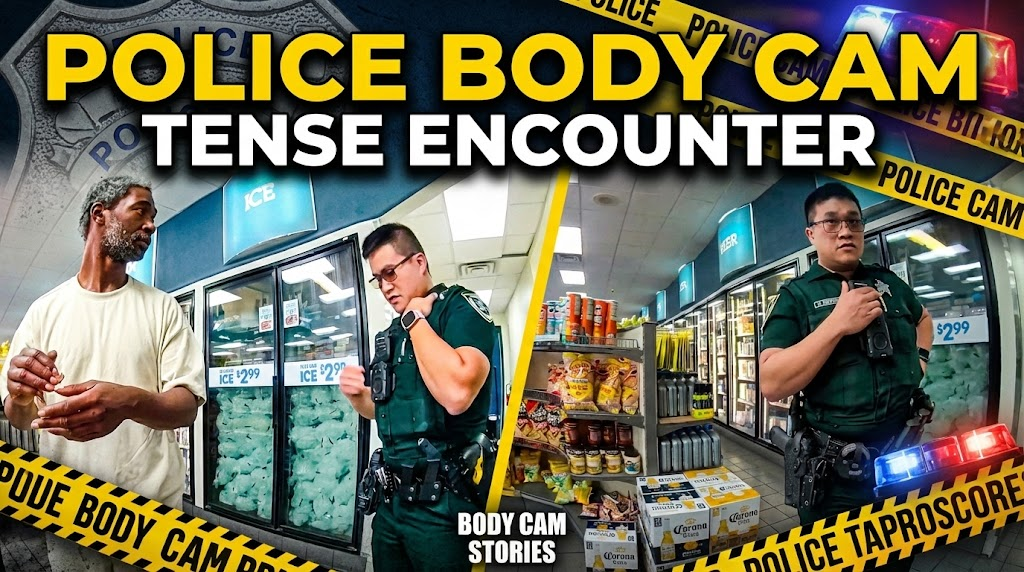


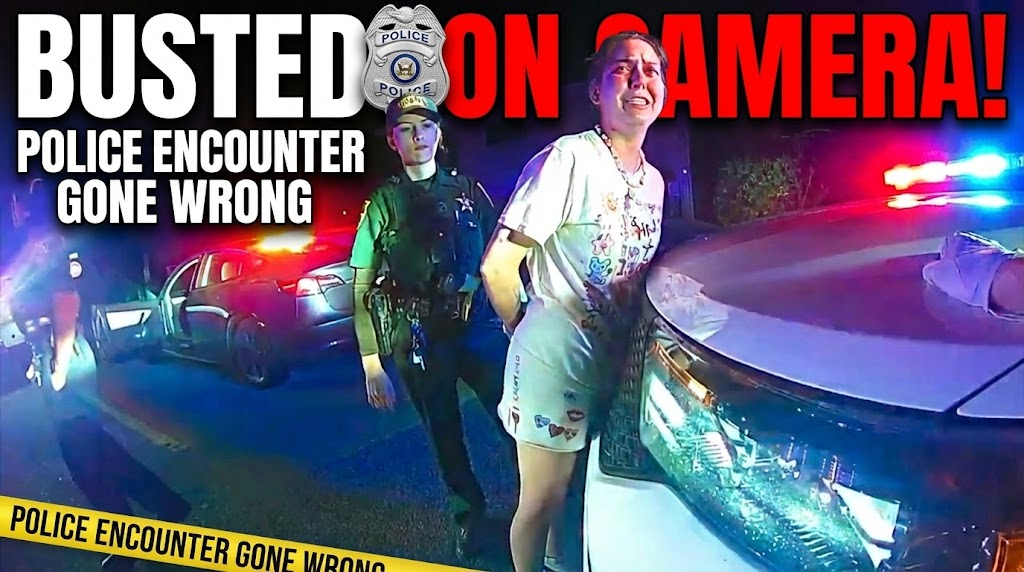
Staged police bodycam videos are the new king of outrage bait
Staged police bodycam videos give a whole new meaning to the phrase bad actor.
Share on FacebookShare on TwitterShare on Flipboard
A staged police bodycam video titled, ’11 Year Old Boy Arrested For Supporting Veterans.’ Credit: Bodycam Declassified / YouTube
Spend a few minutes on TikTok or YouTube, and chances are you’ll run into one of those viral police bodycam videos. A tense traffic stop with racist undertones. A surprise arrest. A drunk, entitled woman gets her fifth DUI. A rookie officer catches a corrupt superior in the act. These clips look real enough to pass at a glance, but some of the bodycam videos currently going viral on TikTok are staged.

The staged body cam videos are the work of a YouTube channel called Bodycam Declassified, which has uploaded 35 videos over the past four months. While many of the videos are staged, the occasional legit bodycam video is mixed in for variety. The YouTube channel has more than 10.2 million views since the account was created in February.

Screenshot from a Bodycam Declassified video titled, “Cop Arrests Black Mail Carrier in Rich Neighborhood.” Credit: Bodycam Declassified
The channel joins a highly trafficked corner of YouTube: police bodycam footage, itself a subgenre of the ever-expanding true crime industrial complex. These videos are usually obtained through Freedom of Information Act requests and have massive audiences. Major players like Police Activity (6.6 million subscribers), EWU Bodycam (2.02 million), Code Blue Cam (2.9 million), and Audit the Audit (2.89 million) have turned this raw, often unsettling footage into algorithm gold.
You May Also Like
Each of Bodycam Declassified clips follows a familiar pattern: a Florida police officer engages with someone (often a person of color), a conflict escalates, and the video ends with some overt moralizing. The titles are ripped straight from a Dhar Mann video — another scripted YouTube channel known for morality plays geared toward a younger audience.
Popular Bodcam Declassified videos have titles such as:
- Stolen Valor Fake Marine Arrested by Police Officer Who Was Real Marine
- Rookie Cop Pulls Over His Powerful Sheriff
- Black Female Officer Busts Arrogant Detective For Parking In Handicap Spot
- Cop Slaps Arrogant Prince in Ferrari and Gets Suspended
- Arrogant Police Officer Pulls Over Black FBI Agent and Regrets It
Bodycam Declassified labels its videos as fictional — sort of. The channel description implies the videos are real, with a lot of hedging. “In our channel, we bring you real, unfiltered bodycam footage, offering insight into real-world situations. In some cases, we may reenact some elements to clarify key aspects of certain encounters.”
However, in an email to Mashable, a member of the “Bodycam Declassified Team” stated, “Yes, the videos on our channel are fully scripted and performed by actors. This is clearly disclosed in multiple places: via watermarks in the footage, on our website, and in our YouTube channel description. Transparency has been a priority from day one.”
SEE ALSO:How to identify AI-generated text
The watermark plastered all over the videos leads to a website that issues bold DMCA warnings against content theft. Here, under a section titled Content Licensing, the site makes it clear:
“Our content is NOT actual bodycam footage.“
However, because the channel’s content is often reposted without permission by clickfarm accounts, viewers may have no idea that they’re watching staged videos.
When we contacted the email address associated with the account, the individual who responded acknowledged this problem. The individual said the channel struggles with “rampant content theft.” They added, “Many of our videos have been re-uploaded without context or credit, often stripped of the disclaimers, and presented on other social platforms as real events. Despite our proactive efforts, takedown processes on many platforms are slow and inconsistent, making it harder to preserve the original intent and integrity of the content.”
Still, the proof is in the details. The police cars in the videos look real enough, but the logos are fabricated and don’t correspond to any real jurisdictions. The videos lack the redactions and face-blurring typical of legally released bodycam footage. Most include timestamps that repeat across clips, indicating batch filming. The upload timeline — just weeks between “incident” and release — is far too fast to reflect real FOIA-based reporting.
Who’s creating these staged police bodycam videos, and why?

A Bodycam Declassified video titled, ‘Mall Security Guard Thinks He’s A Cop. Does Not End Well.’ Credit: Bodycam Declassified
For as long as the internet’s been around, trolling and outrage bait have been a reliable subgenre of social media entertainment. The formula is simple: tap into moments that trigger easy moral outrage — mid-flight meltdowns (another booming category of scripted virality), Reddit confessionals, racist white people, and of course, police encounters.
And in conversations with Mashable, the anonymous creators of Bodycam Declassified hinted at what they want to do next: staged courtroom videos.
In a series of emails to Mashable, the creators of Bodycam Declassified described the project as “part of a larger creative initiative tied to a fictional judge show currently in development.”
“We created these videos to go viral and intentionally left them unresolved to spark conversation and curiosity,” a team member wrote. “The goal was always to circle back with a courtroom series where the same characters and situations are brought before a fictional judge who delivers a verdict.”
The group claims to be behind “hundreds of massively viral videos across a range of online niches” and says they’re building a full-scale courtroom set inside a 10,000-square-foot warehouse, with professional designers who’ve worked on major productions like Bad Boys and Netflix’s Griselda.
“We’ve seen plenty of knockoffs already, but they miss the tone and satirical edge we’re aiming for. That’s why we’ve been deliberate in building this next phase to make sure the final courtroom product lands with the impact we’re setting up now.”

A preview of a Bodycam Declassified video titled, ‘Stolen Valor, Fake Marine Arrested By Police Officer Who Was Real Marine.’ Credit: Bodycam Declassified
SEE ALSO:AI actors and deepfakes aren’t coming to YouTube ads. They’re already here.
They claimed the project is self-funded and declined to provide any production details or internal pitch decks on the project.
Mashable was unable to independently verify these claims. The individual corresponding via email did not provide any identifying information, and when we reached out to Griselda’s lead set designer, Michael Budge, he said he had no knowledge of this project or the channel.
Additionally, when pressed with follow-up questions about the channel — for instance, why their website’s mailing address is registered to a plastic surgery clinic in Fort Lauderdale, which is also the listed address for various crypto and adult content sites — the person promptly stopped speaking to us. Not long after, the address was quietly removed from domain records.
While we were reporting this story, Bodycam Declassified uploaded a new video with the watermark “property of @curbsideconflict” — a handle that had no trace on social media or in trademark records. However, it matches the name of a just-launched YouTube channel focused on parking ticket conflicts (“Woman Refuses To Pay For Parking Because She’s Attractive“). [Editor’s note: Shortly before we published this story, the Curbside Conflict YouTube page was removed from YouTube, along with all of its videos.]
Another recent video on the Bodycam Declassified channel shows a real police encounter in Ohio, which ends with a woman being shot by an officer. The one before that? A scripted scene where the channel’s go-to actor-cop tickets a pregnant woman and her unborn child, followed by an epilogue claiming a judge ruled her unborn child would also be liable for the fine upon his or her birth.
You honestly can’t make this up. Except, clearly, someone is.
If the creators are to be believed, brace yourself for a new wave of courtroom and parking drama ragebait — likely chopped into multiple parts by TikTok clip farmers — featuring the same characters, this time arguing their cases in front of a fictional judge.
Or, maybe they’re simply making ragebait for the love of the game.
Topics Viral Videos YouTube Scams

Chance Townsend
Assistant Editor, General Assignments
Chance Townsend is the General Assignments Editor at Mashable, covering tech, video games, dating apps, digital culture, and whatever else comes his way. He has a Master’s in Journalism from the University of North Texas and is a proud orange cat father. His writing has also appeared in PC Mag and Mother Jones.
In his free time, he cooks, loves to sleep, and greatly enjoys Detroit sports. If you have any tips or want to talk shop about the Lions, you can reach out to him on Bluesky @offbrandchance.bsky.social or by email at chance.townsend@ziffmedia.com.
Conversation1 Comment
Have fun. Be respectful. Feel free to criticize ideas, but not people. Mashable has a strict commenting policy.
Commenting asGuestLog inSign up
Sort by Best
- jjr12 September, 2025came across one that seems really fakeBodycamPOV1https://www.youtube.com/watch?v=Dy0OrDgGUxs&t=30sReplyShare

Home > Life > Digital Culture
Social media reacts as Alex Honnold climbs Taipei 101 skyscraper
Spoilers for the movie ‘Free Solo.’
Share on FacebookShare on TwitterShare on Flipboard

Credit: Netflix
One of the most jaw-dropping athletic feats in recent memory happened this past Saturday, when legendary rock climber Alex Honnold free soloed the Taipei 101 skyscraper live on Netflix.
Formerly known as the Taipei World Financial Center, the building stands 1,667 feet tall, making it the 11th-tallest structure in the world. From 2004 to 2009, it actually held the title of tallest building on Earth, before the Burj Khalifa took that crown. Late Saturday night for U.S. viewers, Honnold climbed the entire thing without ropes, harnesses, or safety equipment, finishing in just over 90 minutes and becoming only the second person ever to pull it off.
It’s hard to overstate how unhinged this is. Thousands of people tuned in to watch the pure, panic-inducing spectacle of a 40-year-old man scaling a skyscraper with nothing but his hands and shoes, the kind of thing your brain immediately rejects as a bad idea. And yet, Honnold made it look almost routine.
When he finally reached the top, his first words summed up the whole experience perfectly: “Sick.”
This Tweet is currently unavailable. It might be loading or has been removed.
Naturally, social media had a field day. Clips and screenshots spread almost instantly, equal parts awe and disbelief, with people marveling not just at the physical feat but at how casually it was presented. A historic athletic achievement, broadcast live, that somehow still felt deeply ridiculous in the best way possible.
This Tweet is currently unavailable. It might be loading or has been removed.
This Tweet is currently unavailable. It might be loading or has been removed.
This Tweet is currently unavailable. It might be loading or has been removed.
This Tweet is currently unavailable. It might be loading or has been removed.
For anyone unfamiliar with Honnold — and mild spoilers, I guess — this isn’t his first time doing a stunt like this. He’s best known for becoming the first person to free solo climb El Capitan, a nearly 3,000-foot vertical granite wall in Yosemite that has killed multiple climbers over the years. That ascent was documented in Free Solo, the 2018 film that went on to win the Academy Award for Best Documentary.
All of which is to say: Alex Honnold isn’t reckless. However, he is, in the most respectful way possible, absolutely out of his mind and also extremely good at what he does.
This Tweet is currently unavailable. It might be loading or has been removed.
This Tweet is currently unavailable. It might be loading or has been removed.
This Tweet is currently unavailable. It might be loading or has been removed.
Topics Netflix Social Media
Chance Townsend
Assistant Editor, General Assignments
Chance Townsend is the General Assignments Editor at Mashable, covering tech, video games, dating apps, digital culture, and whatever else comes his way. He has a Master’s in Journalism from the University of North Texas and is a proud orange cat father. His writing has also appeared in PC Mag and Mother Jones.
In his free time, he cooks, loves to sleep, and greatly enjoys Detroit sports. If you have any tips or want to talk shop about the Lions, you can reach out to him on Bluesky @offbrandchance.bsky.social or by email at [email protected].
Home > Life > Digital Culture
Why everyone on TikTok is using punch cards to hit their goals
In an era of digital burnout, creators are turning goals into punchable milestones.
Share on FacebookShare on TwitterShare on Flipboard

Credit: Mashable composite: TikTok/@lorelaii1010; @christine.schauer; @glowupwithkris
TikTok‘s newest goal-setting trend borrows from an old retail trick: the loyalty punch card. But instead of free coffee, these handmade cards offer users a small, tangible sense of accomplishment.
The appeal may be less about self-improvement and more about the ritual. For millennials and Gen Z —generations raised on sticker charts, gold stars, and achievement tracking — the punch card offers a familiar feedback loop. Creating the card, decorating it, and punching each hole delivers a hit of accomplishment that can feel meaningful even before the goal is fully realized.
Media theorists might recognize this as a form of interpassivity, in which the gesture of progress stands in for the thing itself: by turning goals into punchable milestones, users externalize motivation, letting the card do some of the work, while the satisfaction of the punch becomes its own reward.
“Making punch cards is such a fun way to make goals feel like a game,” creator @caro.fields wrote in the caption of her TikTok. In a follow-up video, she added, “They’re a whimsical way to make your goals feel more approachable.” Creators like her highlight one of the trend’s biggest draws: the act of designing, crafting, and punching the card can feel just as satisfying, and sometimes more immediate, than completing the goal itself.
These punch cards run on a kind of retail psychology. They don’t just offer the promise of a future reward, but proof that you’re getting closer to your goal. The difference is that instead of earning a free drink, users are tracking micro-goals that feel manageable in a chaotic day — five workouts, ten walks, seven days of journaling, a month of language practice broken into punchable steps.
But discipline isn’t the only appeal. In an era of burnout, these cards function more like comfort objects than productivity systems. It’s a tiny routine that makes effort feel tangible and maybe even fun.
And like many productivity trends on TikTok, punch cards often double as aesthetic objects. Unlike apps, no cards look the same. The careful lettering, color coding, and reward sections are as much part of the appeal as the goals themselves, blurring the line between tools meant to be used and objects designed to be seen.
Related Stories
- ‘Admin night’ is the most responsible fun you can have in 2026
- TikTok’s new deeply silly trend? Impersonating owls.
- TikTok says the era of ‘delulu’ is over. It’s time to lock in to reality.
- Why is TikTok so obsessed with 365 buttons?
- The TikTok Awards were messy. I was there.
The punch-card trend also reflects a broader shift toward analog tools in online spaces. From paper planners and bullet journals to analog bags and “dumbphone” experiments, TikTok has increasingly embraced tactile, offline objects as a response to digital overload — and often turning them back into content in the process.
The cards may not guarantee follow-through, but they do offer something immediate: a quick punch, a moment of satisfaction, and the feeling that progress, however small, has been made.
Topics TikTok

Crystal Bell
Digital Culture Editor
Crystal Bell is the Culture Editor at Mashable. She oversees the site’s coverage of the creator economy, digital spaces, and internet trends, focusing on how young people engage with others and themselves online. She is particularly interested in how social media platforms shape our online and offline identities.
She was formerly the entertainment director at MTV News, where she helped the brand expand its coverage of extremely online fan culture and K-pop across its platforms. You can find her work in Teen Vogue, PAPER, NYLON, ELLE, Glamour, NME, W, The FADER, and elsewhere on the internet.
She’s exceptionally fluent in fandom and will gladly make you a K-pop playlist and/or provide anime recommendations upon request. Crystal lives in New York City with her two black cats, Howl and Sophie.