


High ranking ONGC officer trapped in digital scam:Cyber fraudsters posing as CBI officials, stole ₹1 crore 36 lakh in 6 days
Sangamben (name changed), a high-ranking officer at ONGC in Ahmedabad, was going about her regular day when her mobile phone rang. The number was unfamiliar, yet she answered.
“Hello?” she said, expecting a routine call.
A woman’s voice, calm yet almost threatening, came from the other end: “Your phone will be switched off in two hours.”
Before Sangamben could respond or even process what she had heard, the call abruptly ended. Something felt wrong. She tried calling back the number. This time, a man answered.
“I just received a call from this number,” Sangamben said cautiously.
“Okay,” the man replied in a heavy, measured voice.
“Who are you? And why will my phone be switched off?” Sangamben asked, perplexed.
“I am Rakesh Sharma from TRAI,” the man said. “In a while, you will receive a call from our senior officer. Please wait.” And then, the call ended again.
Sangamben was frustrated and confused. Everything about the conversation the tone, the number, the apparent official identity—felt legitimate. Her phone showed no “spam” alert or warning. She thought to herself, I’ll wait and see what happens next.
The Threat of Arrest
A little while later, her phone rang again. This time, it was a WhatsApp video call. Sangamben answered. On the screen appeared a man in a police uniform. His voice was stern:
“I am speaking from Bombay CBI. Two crore rupees of black money have come into a Canara Bank account linked to your Aadhaar card. This means you are involved in this fraud. You are under arrest.”
The shock left Sangamben speechless. How could this happen? How could even an educated, high-ranking officer like herself fall prey to such a scheme?
Digital arrest scams have become increasingly common over the last few years. Cybercriminals routinely pose as police officers, CBI agents, or other officials, extorting millions from unsuspecting victims through calls and WhatsApp messages.
Most people assume such fraud targets the elderly, rural citizens, or those less educated. But Sangamben’s case proved otherwise: she was well-educated, held a prominent position, and had worked for one of India’s largest public sector companies. Yet, she became a victim of a meticulously crafted digital trap, losing a staggering ₹1.36 crore in just six days.
How Digital Arrest Scams Work
The modus operandi of these cybercriminals is disturbingly simple but terrifyingly effective. They exploit fear, authority, and a sense of urgency. In Sangamben’s case, it began with a call that threatened to shut off her phone. Then, a series of video and audio calls on WhatsApp escalated the fear, making her believe she was being investigated by the CBI.
The first video call featured a man in a police uniform claiming to be a CBI officer from Mumbai. He accused her of being involved in a two-crore-rupee black money fraud and said she was under arrest. He instructed her to cooperate with his “senior officer” during further interrogations, insisting she answer questions truthfully.
Despite knowing about such scams, Sangamben felt a mysterious unease. She worried that her Aadhaar card could indeed be linked to black money fraud and feared the implications on her career.
Her mind oscillated between disbelief and panic. Should she consult someone? Should she remain silent? Before she could decide, another WhatsApp call arrived, this time audio only.
Phone Surveillance and Threats
The voice on the other end was menacing:
“As my colleague informed you, an arrest warrant has been issued. You will be interrogated further. Do not turn off your phone. Keep it charged. Your phone is under tracking. Do not let anyone enter your house, and do not go anywhere without our permission. You cannot receive any other calls.”

Sangamben’s fear intensified. She trembled as the “officer” began asking questions. First, he wanted to know who was in her house. She responded honestly: “My mother and I live alone.”
“Provide your mother’s number as well. She will also be put under tracking,” he demanded. Frightened, Sangamben gave her mother’s contact. The “officer” then instructed her to draft an application, which she wrote in Gujarati and sent via WhatsApp. Soon, the same “officer” returned it, stamped with the seal of the Supreme Court Bar Association.
Seeing the official seal, Sangamben became convinced that a genuine arrest warrant had been issued. The officer then told her that there was a way to resolve the matter quickly but left her in suspense by abruptly cutting the call.
The Illusion of Justice
On June 1, 2025, Sangamben received another WhatsApp call. She was told to answer written questions sent via WhatsApp. The next day, around 10 a.m., she received a video call from someone claiming to be a manager at Bombay CBI.
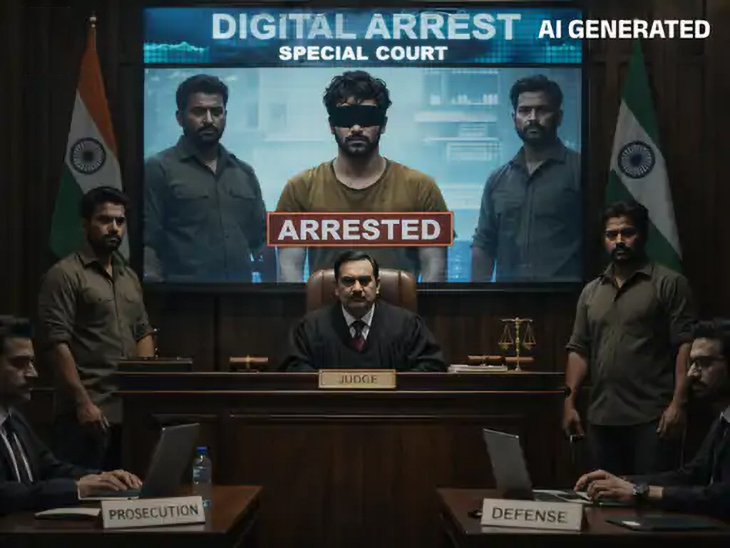
“This is Judge Gogoi,” said the person on the screen, seated in a courtroom setting. He instructed Sangamben to show her Aadhaar card and asked about the source of the money in her accounts. She complied, terrified by the courtroom ambiance and the seeming authenticity of the interaction.
The “judge” informed her that the Reserve Bank of India would verify the ₹36 lakh in her account and directed her to transfer it into an IndusInd Bank account under the name ‘A. R. Infotech’. Frightened and convinced of the legitimacy of the call, Sangamben transferred ₹36 lakh immediately via RTGS.
The threats and demands did not stop there. On June 3, she was instructed to transfer ₹35 lakh from her fixed deposit into a Bank of Maharashtra account. On June 4, she was told to transfer another ₹15 lakh into a different account at the same bank.
By June 5, the fraudsters extended their demands to her mother’s account. Sangamben and her mother transferred another ₹35 lakh to a Yes Bank account. Within six days, a total of ₹1.36 crore had been drained from their accounts.
Even after transferring the massive sum, the fraudsters demanded an additional ₹50 lakh as “bail security” to return the money. Sangamben, exhausted and terrified, told them she could not raise the amount immediately.
Realization and Filing a Complaint
At this point, Sangamben finally informed her uncle, an educated and aware individual. Upon hearing the story, he immediately recognized the crime:
“Daughter, a very big fraud has happened. You have been cheated. Such a huge amount has been extorted from you,” he said.
Sangamben was devastated. Her life savings had vanished in a matter of days. Her uncle encouraged her to report the matter to the police. She filed a complaint with the Ahmedabad Cyber Crime branch, detailing the digital arrest scam and the ₹1.36 crore loss.
Investigating the Fraud
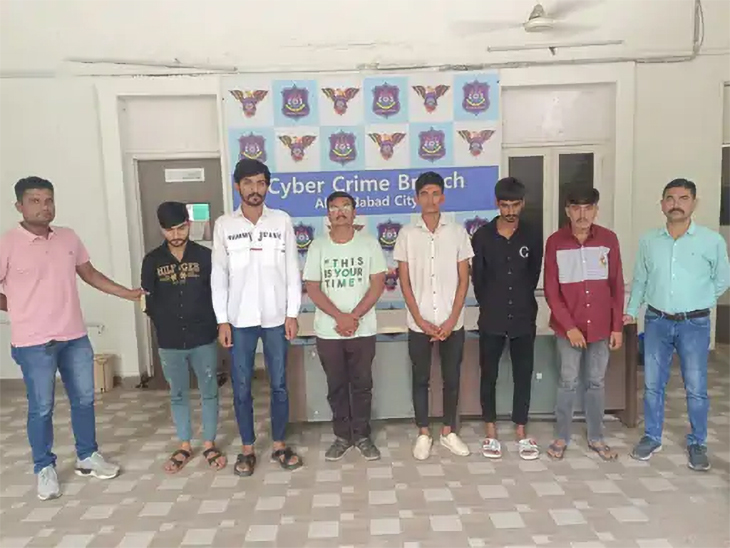
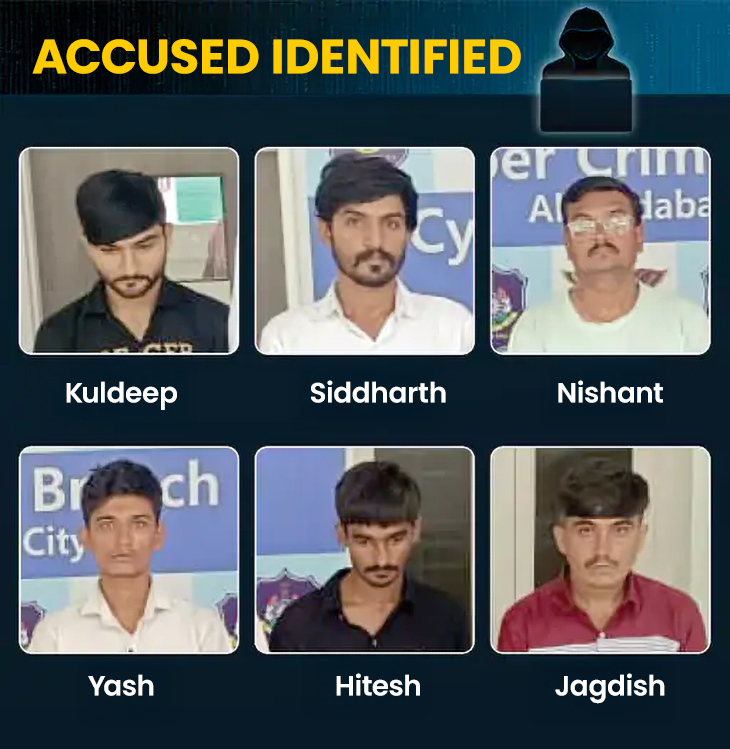
Upon receiving the complaint, Ahmedabad Cyber Crime launched an immediate investigation. Inspector C. T. Desai led the team. Their probe revealed that ₹25 lakh had been transferred to a Bandhan Bank account belonging to Nishant Rathod.
Nishant Rathod admitted that the account had been opened under instructions from Yash Patel. Both individuals had prior online fraud cases registered with Vadodara Cyber Crime. Further investigation connected them to other accomplices: Kuldeep, Hitesh, Jagdish, and Siddharaj.
These individuals provided bank accounts and mobile numbers to cybercriminals operating from abroad, who executed the fraud. The money was ultimately transferred overseas through USDT, a cryptocurrency, leaving the perpetrators safely out of India.
The Scale of Digital Arrest Scams
Sangamben’s case illustrates how sophisticated digital frauds have become. Criminals exploit technology, fear, and perceived authority to manipulate even highly educated and cautious individuals. They orchestrate elaborate schemes involving video calls, official-looking documents, fake courtrooms, and staged identities of officers or judges.
The fraudsters are careful to build psychological pressure gradually. Initial threats and warnings escalate to specific instructions, creating urgency and fear. By isolating victims and instructing them not to speak with anyone, they ensure compliance. This combination of intimidation, timing, and technical sophistication makes even experienced professionals vulnerable.
Recovery Status
Months after the incident, Sangamben has yet to fully recover financially or emotionally. Speaking on the phone about her experience, she shared that some portion of her lost money has been recovered, but a significant amount is still missing.
“The shock was immense,” she admitted. Even though a part of the amount has been returned, the trauma of being manipulated and losing her life savings remains.
Lessons Learned
Sangamben’s experience serves as a cautionary tale. Digital frauds are no longer limited to unsuspecting elders or rural individuals. Cybercriminals are increasingly targeting educated professionals and high-ranking officials, exploiting trust, authority, and fear.
Authorities advise that any unexpected calls claiming legal or governmental authority should be treated with suspicion. Verification through official channels, refraining from transferring money, and consulting family or legal advisors before taking action can prevent such tragedies.
In Sangamben’s case, even years of education, professional experience, and common sense were insufficient against the carefully constructed web of psychological manipulation and digital tactics employed by cybercriminals.
The story of Sangamben, the ONGC officer, is a grim reminder of the vulnerabilities inherent in today’s digital world. In just six days, she lost ₹1.36 crore to fraudsters posing as CBI officers and judges, all orchestrated via WhatsApp and bank transfers. The investigation revealed a complex network of accomplices both in India and abroad.
As digital crime evolves, so must awareness and vigilance. Sangamben’s ordeal underscores the need for robust cybersecurity practices, widespread awareness, and careful verification before complying with any seemingly urgent legal or financial demand.
The digital world, for all its convenience, carries risks as real as any physical threat—sometimes even more sophisticated and psychologically manipulative. Sangamben’s story reminds us that no one is immune, and vigilance is the first line of defense.
Family fights for man’s release from ICE custody, details conditions at Broadview facility
Immigration judges can no longer grant bond for immigrants who entered US without authorization
A family is fighting for a father’s release from ICE custody after his Crestwood arrest. They also detailed conditions at a Broadview facility.
CHICAGO (WLS) — For hours, Mariana Cabrera said she and her family had no idea where her father was; the only clues they had came from a three-minute surveillance video.
It was just after 11 a.m. on Friday, Oct. 3, when her father, Ramiro Cabrera, his nephew and another colleague working for the family business “Cabrera Rental Center” were setting up a tent in a Crestwood business parking lot.
ABC7 Chicago is now streaming 24/7. Click here to watch
That’s when a white van pulled up.
In the surveillance footage shared with the ABC7 Chicago I-Team, federal agents dressed in fatigues exited the van, talked to Cabrera and his nephew, and, in less than three minutes, the men were escorted to the van, which drove off.
The Cabrera family found themselves in the same situation as many families of loved ones caught up in “Operation Midway Blitz,” the administration’s codename for increased immigration enforcement happening across the Chicago area.
Ramiro Cabrera was arrested by federal agents after living in the U.S. without legal permission for more than 20 years, according to court filings.
Now, Cabrera is getting legal assistance from an unexpected ally, who has experience straight from the bench: a former assistant chief immigration judge who was fired by the Trump Administration earlier this year.
The arrest and detention of Cabrera, a 51-year-old father of four American children with no criminal record, also brings to light allegations of poor conditions inside a local Immigration and Customs Enforcement processing facility at the center of serious controversy locally.
Officials with the U.S. Department of Homeland Security have vehemently denied any “subprime conditions” in the facility.
When Fernanda Cabrera first saw the surveillance footage of her father being detained, she told the I-Team she was speechless.
Chicago federal intervention: Tracking surge in immigration enforcement operations | Live updates
“You see on social media other videos of people getting taken by ICE, and you’re like, ‘Wow, this is insane,'” Fernanda Cabrera said. “And then, seeing a video and saying, ‘That’s my father. That’s my dad.’ He was at work. It was pretty heartbreaking. It felt very unreal.”
Mariana Cabrera agreed, adding that after agents detained her father and his nephew, the business’ supplies and truck were left in the parking lot. Even her father’s wallet was left behind. It was hours until she said her father first called the family to tell them what happened from the Broadview ICE facility.
“The moment they put him in a van, we didn’t know where he was going,” Mariana Cabrera said.
That’s when the family’s attorney, former U.S. Assistant Chief Immigration Judge Jennifer Peyton stepped in and acted quickly, filing a petition in federal court to halt their father’s transfer to an ICE detention facility farther away from the Chicago family.
“We filed a petition in federal court called the (writ of) habeas because I did not want him going to Louisiana or Texas,” Peyton told the I-Team.
The I-Team was there when Peyton packed up her office, after she was abruptly fired from helping lead Chicago’s immigration court this past July.
According to the termination letter shared with the I-Team, no reason was given for Peyton’s termination.
Now, Peyton said she’s representing the kinds of clients she used to rule on.
“As an immigration judge, I would hear cases where respondents told me about their governments acting with impunity,” Peyton said. “And now, I’m seeing it myself, which is insane.”
Examples of impunity, Peyton says, include how the Broadview ICE processing facility is used.
That’s where Cabrera was taken, and where most, if not all, migrants detained by federal agents in the Chicago area pass through.
“My client that was taken there told me that (Broadview is) so overrun with detainees that they’re sleeping inside the bathrooms, on the floors,” Peyton said. “They’re not offered showers. They’re held there for multiple days, people upon people upon people, with no access to counsel.”
Democratic lawmakers said they have been turned away from the Broadview location after requesting a tour of the facility.
“We just want to go in and look at this facility, and see what the conditions are. And they will not let us in,” U.S. Sen. Tammy Duckworth said on Oct. 10.
On that same day, U.S. Sen. Dick Durbin said, “I’ve never had this kind of stonewalling by any presidential administration. Something’s going on in there that they don’t want us to see.”
DHS did not respond to questions about lawmakers being denied access to Broadview.
A spokesperson for DHS rejected claims of “subprime conditions” inside the Broadview facility, telling the I-Team, “ICE has higher detention standards than most U.S. prisons that hold actual U.S. citizens… All detainees are provided with proper meals, medical treatment, and have opportunities to communicate with lawyers and their family members.”
In a court filing tied to Cabrera’s case, Peyton writes, “Broadview is a black hole. When my clients are there, I am unable to speak to them or contact them.
“With ICE officers, I’ve said, ‘Can I visit?’ No, you can’t. ‘Can I make phone calls?’ No, you can’t. ‘How do I get a hold of them?’ They can call you. And I’m like, that’s not- that’s insufficient.”
Cabrera’s daughters said when their father was given a phone call from the Broadview facility, they were left feeling worried about him.
“We got one phone call for about maybe one minute, just saying where he was and just his voice was just so shaken,” Mariana Cabrera said. “There’s so many people in there trying to get phone calls that, I mean, still today, we’re struggling to get phone calls.”
Cabrera was eventually transferred to an ICE detention facility in Indiana.
“His absence is definitely felt,” Fernanda Cabrera said, “He has his, like, specific spot on our couch at home. And seeing it empty every night, it’s heartbreaking.”
Bond Decision Could Impact Millions
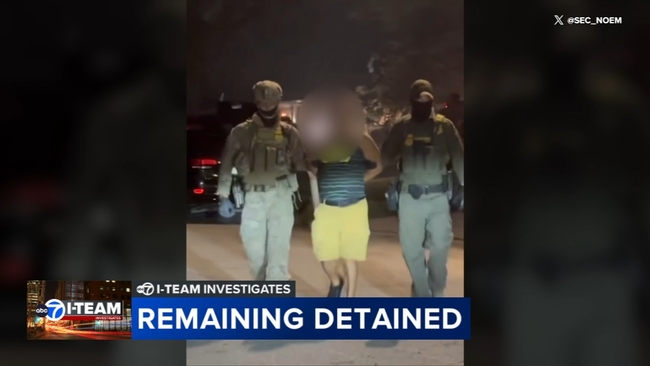
Immigration judges can no longer grant bond for immigrants who entered the U.S. without authorization.
Later this week, Peyton will argue before a federal judge that Cabrera’s detention was an “unlawful violation of due process and an incorrect interpretation of immigration law.”
The government plans to contest that.
But that “interpretation of immigration law” centers around a quiet decision released last month in the immigration court system that could impact millions of people across the country.
On Sept. 5, the Board of Immigration Appeals, the top administrative body which interprets and applies immigration laws, released a new decision titled, “Matter of Yajure Hurtado.”
For the first time in American history, the decision ruled immigration judges can no longer grant bond for immigrants who entered the U.S. without authorization.
Immigrant advocates say it all but guarantees mandatory detention for those detained.
A spokesperson for DHS called the ruling, “a big win for our ICE attorneys securing our ability to detain illegal aliens until they are deported.”
ABC 7 Chief Legal Affairs Analyst Gil Soffer told the I-Team it’s a “monumental decision.”
“Obviously, the effect of it is to make it impossible for people to post and be released on bond. Whereas in the past, there wasn’t that automatic rule,” Soffer said. “So, it’s a very significant change, and I think we’re going to see a real fight over it.”
With regards to Cabrera’s habeas petition filed in federal court, “What we’re seeing in this habeas petition is, for the first time, just taking issue with a decision of the immigration courts that really has changed the picture dramatically. It’s a different kind of argument because it’s a different kind of ruling without precedent.”
Immigrant advocates and attorneys say it’s a total sea change.
“It overturned decades of case law, of regulations and laws indicating that for someone who is here without authorization, that they are entitled to a bond if they can show that they are not a flight risk or danger to the community,” Peyton said. “For someone who is here without authorization, the only remedy now is to go to federal court.”
Cabrera’s court date is scheduled for Oct. 23.
His daughter, Mariana, remains hopeful her father will return home to see his grandchildren soon.
“I have two kiddos with another one on the way,” Cabrera said. “It’s been heartbreaking for the oldest three, and for us to go to abuelo’s house and to not see abuelo.”
York officer shooting tied for most deadly incident in state’s recent history
Officer-involved shooting in York County leaves three officers dead and two wounded after a suspect opens fire during an arrest. It is now tied for the deadliest.

Credit: Officer Down Memorial Page
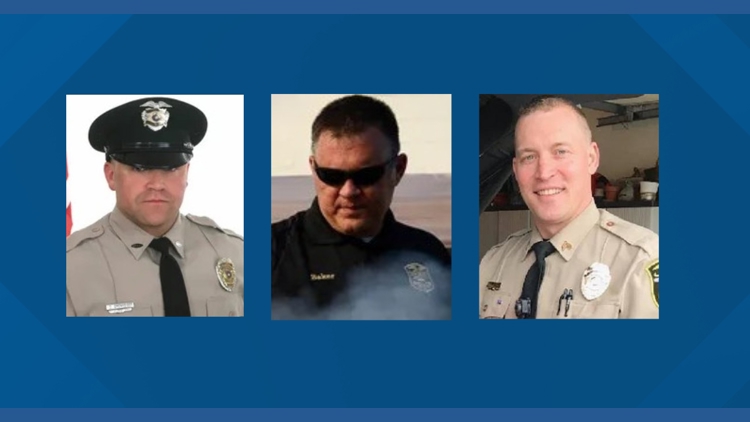
From left to right: Detective Isaiah Emenheiser, Detective Mark Baker, Detective Sgt. Cody Becker
Author: Nate Soisson
YORK COUNTY, Pa. — Another officer-involved shooting in York County has left the community grieving and speechless. Officers were killed on Wednesday, Sept. 18, while searching for Matthew Ruth, a suspect in a local stalking case who staked out his ex-girlfriend’s family home with an assault rifle in North Codorous Township.
When police arrived to serve Ruth an arrest warrant, he opened fire on them as they oepened the front door, leading to the deaths of Detective Isaiah Emenheiser, Detective Sgt. Codey Becker and Detective Mark Baker, and the wounding of two others before he was shot down by law enforcement.
This incident is now tied for the most deadly officer-involved shooting in Pennsylvania’s recent history.
The shooting comes on the heels of another York County officer death, Andrew Duarte of West York Borough Police Department, in February at UMPC Memorial Hospital. In just eight months’ time, York County has seen four officers killed by active shooters across the region.
In another incident 15 years ago, on April 4, 2009, Pittsburgh saw another devastating attack, where a heavily armed man opened fire on two Pittsburgh officers who were responding to a domestic violence call at the actor’s mother’s home.
Upon arrival, Paul Sciullo and Stephen Mayhle were shot, killing both of them. When a fellow officer, Eric Kelly, arrived to assist his late brothers, he too was killed. Three other officers were injured in the standoff that followed.
In 2014, Eric Frein was another person who was responsible for one officer’s death before leading a 48-day manhunt as he attempted to evade capture in Pike County. Frein was later ambushed, arrested and sentenced to death for his actions.
Pennsylvania ranked No. 5 in 2019 for the most dangerous states to police across the country.